


Una peregrinación a través de los apóstoles
I see a guy who’s willing to follow Jesus. Willing to die for him, actually.
Look at John 11. The authorities want Jesus gone, and the disciples know it. Going back toward Judea is dangerous, and everyone in the room can feel it. Thomas speaks up anyway: “Let us also go, that we may die with him.” He means it. What he doesn’t do, I think, is comprehend who Jesus is. He sees what’s in front of him, here and now, and he sees it as finite.
That fits the man. Thomas is black and white, a realist. A boss once told me I was very black and white, and she had a point. But I’ve noticed something about myself too. I like numbers now, though I was sure I hated them when I was young, because numbers don’t hide secrets if you pay attention. I need proof. I think Thomas did too.
While in the chapel, I saw something different between Thomas and me. My questions are constant. I am always looking. Thomas’s questions seem to pop up through conversation. Jesus says something, Thomas cannot make it fit with what he knows, and then he asks. Maybe we both seek, but we do it differently.
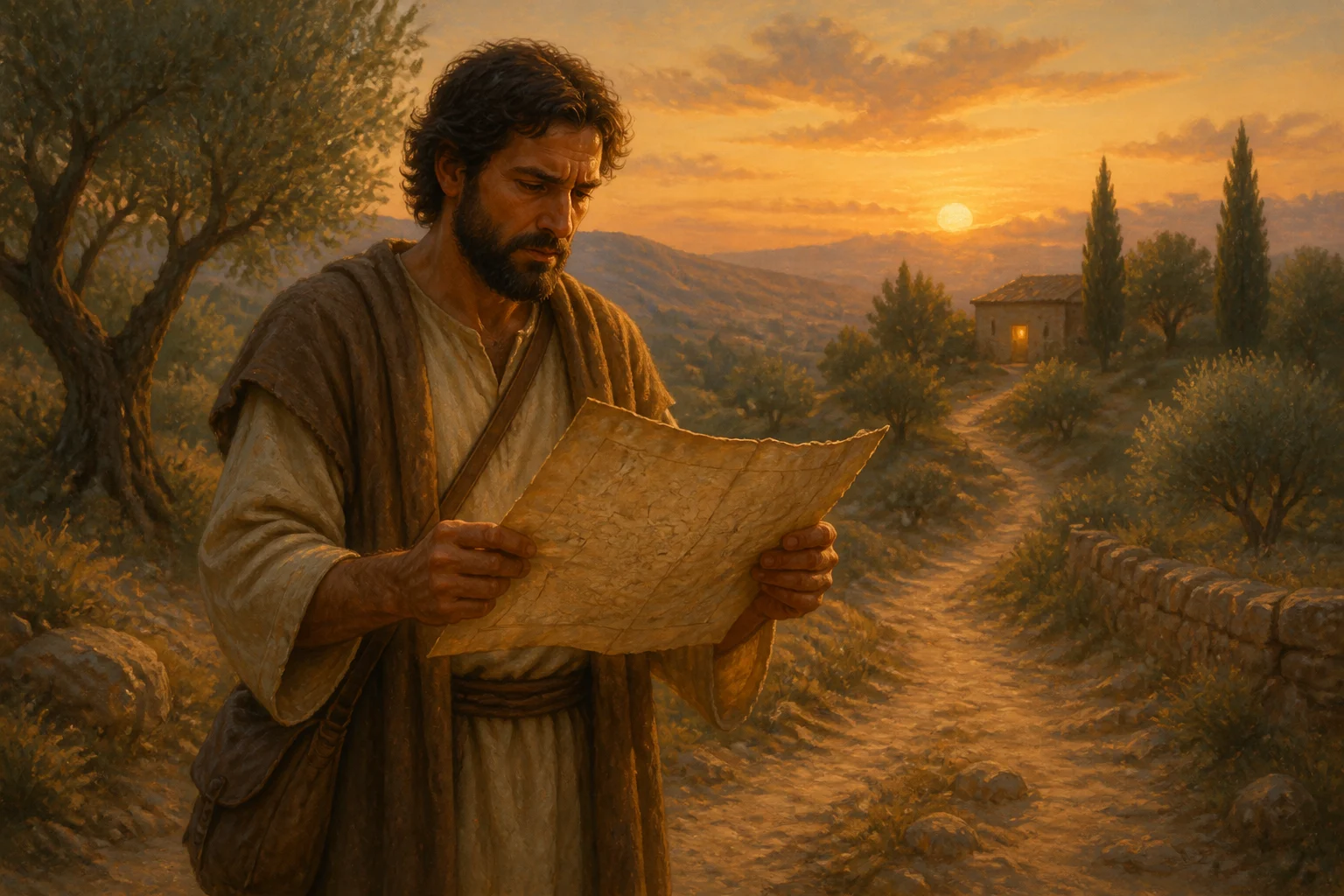
Which brings me to John 14. Jesus talks about his Father’s house and its many rooms, and I think Thomas hears a house. A destination, something physical. My goodness, this must be a huge house. So he asks how they can know the way. In my head he’s saying, give me my Rand McNally and I’ll follow you. Not Google Maps, not Waze, because those live on a screen. A paper map in your hand is a different thing altogether, and Thomas is a paper map man.
Then Jesus says, “I am the way.” I believe you can almost hear Thomas’s mind going. What does he mean, I’m the way? Click, click, click. That doesn’t mean he understood. I think it means the pieces were starting to line up.
John 20 is the same man. He watched Lazarus come out of the tomb, and he knew Jesus had died. The one who gives life, dead. How can it be? To a black-and-white mind, death is complete, and he hasn’t yet put it all together. So when he says he has to probe Jesus’ hands and side, I don’t hear doubt. I hear Thomas not seeing yet. Then Jesus stands in front of him and Thomas says, “My Lord and my God.” I don’t think he needed the probing at all. Once he sees, it’s over. He’s sold. It’s as if the film covering his mind’s eye falls away and everything is confirmed.
So the man who would die with Jesus is the same man who needs to see him before he believes the others’ report, and I don’t think that’s a contradiction. Thomas has faith in Jesus. He just doesn’t understand completely, and he keeps following while his faith grows. I believe faith grows through our lives. We aren’t at 100 percent when we decide to follow. It is a process that we go through.
Maybe what we perceive as doubting is just the process of growth in faith in God.
I believe most of us are like that. We can truly believe in the Trinity, even though we can never fully comprehend the Trinity. There’s a prayer for exactly that, from a father in Mark 9: “I believe; help my unbelief!”
These writings are me asking questions and looking for answers. The apostles are just like us. There’s no difference between the men Jesus walked with then and the people he walks with today.
So I’m asking you. Read John 11, 14 and 20, then sit with these:
- Thomas says, “Let us also go, that we may die with him.” What does that tell you about his loyalty, and what does it leave out about his understanding?
- Is Thomas afraid in John 11, or is he seeing the danger plainly?
- When Jesus talks about his Father’s house, what do you think Thomas pictures?
- “How can we know the way?” What is Thomas really asking for?
- Jesus says, “I am the way.” What do you think Thomas begins to understand?
- What do you need to see before you can believe? Where are you a paper map person in your own faith?
- Thomas had watched Lazarus come out of the tomb. Why was Jesus’ death so much harder for him to fit together?
- In John 20, is Thomas doubting or not seeing yet? Does the difference matter?
- “My Lord and my God.” What changed for Thomas in the moment he saw?
- Where are you going through the motions right now, believing without fully understanding? What would “I believe; help my unbelief” sound like in your own words?
“I believe; help my unbelief!” —Mark 9:24, RSV-2CE
Referencias y notas
John 11:1–44 — Jesus returns to Judea, raises Lazarus, and Thomas says, “Let us also go, that we may die with him” (John 11:16).
John 14:1–7 — Jesus speaks of His Father’s house. Thomas asks how the disciples can know the way, and Jesus answers, “I am the way, and the truth, and the life” (John 14:5–6).
John 20:24–29 — Thomas asks to see the wounds of the Crucifixion. When Jesus appears, Thomas answers, “My Lord and my God!” (John 20:28). The passage does not say whether Thomas touched Jesus’ wounds.
Mark 9:14–29 — The father of the afflicted boy says, “I believe; help my unbelief!” (Mark 9:24).
Scripture quotations and references are from the Revised Standard Version, Second Catholic Edition (RSV-2CE).
Deja un comentario