


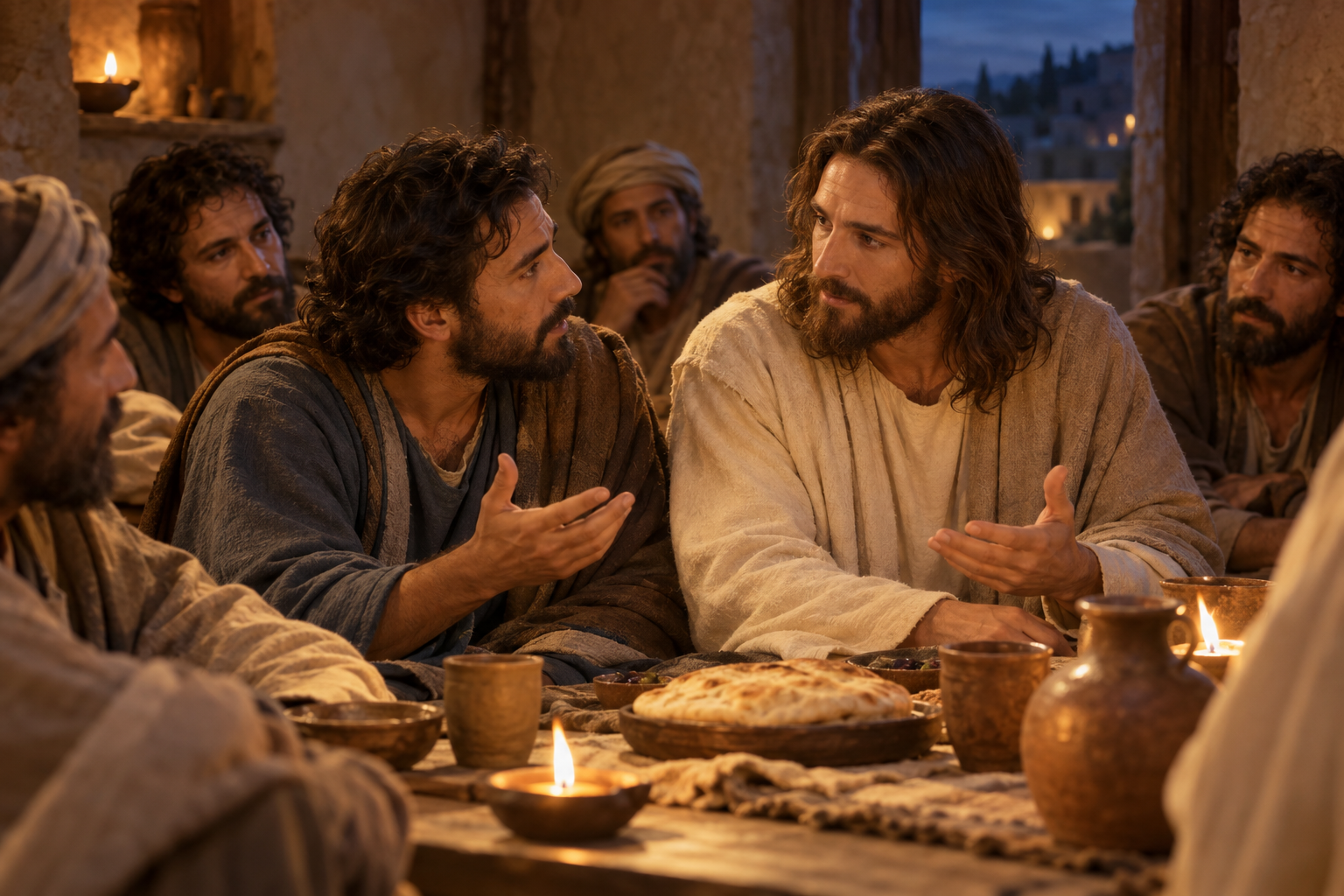
Philip
Back in 1971, a pathologist in Italy reported that the flesh preserved from a miracle traditionally dated to the eighth century was human heart tissue. The blood, he said, was type AB. [1]
Over the years the findings have been disputed. It’s interesting not as proof, but it brings up questions: what can this tell us, and what questions remain?
Have you ever been so sure of the numbers that what happened didn’t make sense?
That’s what I see in Philip.
Following Philip through these passages brings those same limits into view. What do we do when our understanding runs out?
Across Philip’s encounters with Jesus, a pattern begins to emerge: what he can see clearly, and what he is still learning to see.
Imagine yourself as Philip. Jesus finds you and says:
“"Sígueme."”
John 1:43
You answer the call.
What were you thinking in that moment when he asked? What were you feeling?
For Philip, the next step is finding Nathanael and telling him:
“We have found him of whom Moses in the law and also the prophets wrote,”
John 1:45
He names Jesus of Nazareth, the son of Joseph. By his response, I believe he may have known his Torah well enough to put it together.
That leads me to think Philip was knowledgeable and analytical.
Faced with Nathanael’s skepticism, Philip offers a simple invitation:
“Come and see.”
John 1:46
I don’t think Nathanael was pushed away, or that Philip wasn’t convincing. Nathanael may be a see-and-touch kind of person, closer to Thomas than to Philip.
Bringing someone to Jesus was only the beginning for Philip. He had found the one Moses and the prophets wrote about. But following him would bring questions that knowing Scripture couldn’t answer. One of them came by the Sea of Galilee, and it came from Jesus himself.

A large crowd has followed Jesus, and he asks Philip:
“How are we to buy bread, so that these people may eat?”
John 6:5
John tells us he asked this to test him, because he already knew what he would do. (John 6:6)
Philip answers:
“Two hundred denarii would not buy enough bread for each of them to get a little.”
John 6:7
His answer makes sense. There are about five thousand men, and a denarius is roughly a day’s wage. Philip saw the problem clearly, and he stopped there. (John 6:10; Matthew 20:2)
Andrew sees the shortage too. He points out a boy with five barley loaves and two fish and asks:
“What are they among so many?”
John 6:9
But he points to what they have anyway, in spite of not seeing the answer completely. So I see Andrew as in a different place along his pilgrimage.
Philip seems to be very black and white. That doesn’t mean he’s unwilling to learn or change. The numbers just leave him without a way forward. They are too concrete. Jesus never corrects his arithmetic.
I believe the test was meant to bring out Philip’s limit, to open him to possibilities, and to show that math doesn’t answer every question. I think he allows him to discover the answers along the way. That black and white has room for faith.
Philip saw the problem clearly through numbers. Jesus was standing nearby.
Later, the two men appear together again, this time with people seeking Jesus rather than food for a crowd. Some Greeks have come to worship at the feast, and they approach Philip. (John 12:20–21)
Put yourself in their place. You’re an outsider who wants to see Jesus, and you don’t know how to reach him. Who do you ask? For these visitors, it is Philip, the man from Bethsaida in Galilee:
“Sir, we wish to see Jesus.”
John 12:21
I think he may be approachable, or simply the first disciple they meet. Look at what he does. He doesn’t decide on his own. He slows down, goes to Andrew, and the two of them take it to Jesus together. (John 12:22)
Perhaps that thoughtful way of listening was one of the qualities Jesus saw in Philip when he called him. What might he see in you and me?
Jesus answers by announcing that the hour has come for the Son of Man to be glorified. It is a much larger answer than we might expect. The interesting thing I noticed was John never tells us whether the Greeks met him. The Greeks were outsiders, and I wonder if John leaves it open because the invitation was never meant to end with them. (John 12:23–32)
Their request carries into the next encounter. These visitors want to see Jesus. At the Last Supper, Philip himself will ask to see the Father.
Around the table, Thomas asks:
“Lord, we do not know where you are going; how can we know the way?”
John 14:5
As Jesus explains, he speaks of knowing the Father and says:
“henceforth you know him and have seen him.”
John 14:7
Hearing about seeing the Father, Philip responds:
“Lord, show us the Father, and we shall be satisfied.”
John 14:8
After following Jesus, listening to him, and witnessing his works, Philip still hasn’t reached a complete understanding. I think Thomas’s question has stirred one of his own in Philip, and Jesus’ answer has opened it further. The request sounds familiar by now: show me plainly, so I can understand.
Jesus answers him directly:
“Have I been with you so long, and yet you do not know me, Philip?”
John 14:9
My first reaction was that surely, by now, they would understand. They had spent all that time with him. But knowing someone and fully understanding who he is are different things. Jesus gives him something concrete to consider:
“or else believe me for the sake of the works themselves.”
John 14:11
Philip is like Christians who see Jesus and accept him but don’t fully see. How many of us can understand where he is?
For me, coming back to the table means going to Church, listening to people who know more than I do, and reading. Not just one source, but all of them. There is always more to understand, and other people can help me notice what I have missed.
At the table, Philip asked his question out loud, in front of the others. Earlier, when the Greeks approached him, he sought out Andrew. Philip asks, listens, and brings the questions into the company of others.
“So where does your seeing run out? Ask. Then come back to the table.”
Which apostle do you see yourself in? Tell me in the comments. I’d like to know.
Referencias
Para quienes deseen profundizar, estas fuentes dieron forma a esta reflexión.
Sagrada Escritura
John 1:43–51 — Philip’s calling and his invitation to Nathanael.
John 6:1–15 — Jesus tests Philip and feeds the crowd.
John 12:20–36 — The Greeks approach Philip; he and Andrew tell Jesus together.
John 14:1–14 — Thomas asks about the way, and Philip asks to see the Father.
Matthew 20:1–16 — A denarius as a day’s wage in Jesus’ parable.
Further passages naming Philip among the apostles: Matthew 10:1–4 · Mark 3:13–19 · Luke 6:12–16 · Acts 1:12–14.
On reading Philip
The portrait of Philip and the connections to our own lives are my reflections on these passages. Scripture records his words and actions without explaining every thought or motive. I invite you to read them and consider what you see. Philip the apostle is distinct from Philip the evangelist, identified in Acts 21:8 as one of the seven.
[1] Lanciano, Italy
Odoardo Linoli’s 1971 study, “Ricerche istologiche, immunologiche e biochimiche sulla carne e sul sangue del miracolo eucaristico di Lanciano (VIII secolo),” appeared in Quaderni Sclavo di Diagnostica Clinica e di Laboratorio 7(3), pp. 661–674. The PubMed record provides the publication details. The Carlo Acutis exhibition account (Italian PDF) summarizes the reported findings of human heart tissue and blood group AB. The eighth-century date is the traditional date of the event, rather than a date established by the tissue examination.
Buenos Aires, Argentina
Frederick T. Zugibe’s letters of March 15 and March 26, 2005 describe his examination of a slide in April 2004, associated in the accompanying material with the reported 1996 Eucharistic event in Buenos Aires. He identified cardiac tissue with degenerative changes and inflammatory cells. These are the written findings for readers who wish to look further.
Fátima, Portugal
El Shrine of Fátima’s chronology, in its October 13, 1917 entry, includes an excerpt from journalist Avelino de Almeida’s eyewitness account, published in O Século on October 15. It describes the apparent movement of the sun at the gathering. The chronology also records the bishop’s 1930 recognition of the apparitions as worthy of belief.
A note on these accounts
The tissue reports describe the samples examined; the Fátima account is historical testimony. I include them as invitations to read and think, rather than as scientific proof of a miraculous cause.
Deja un comentario