


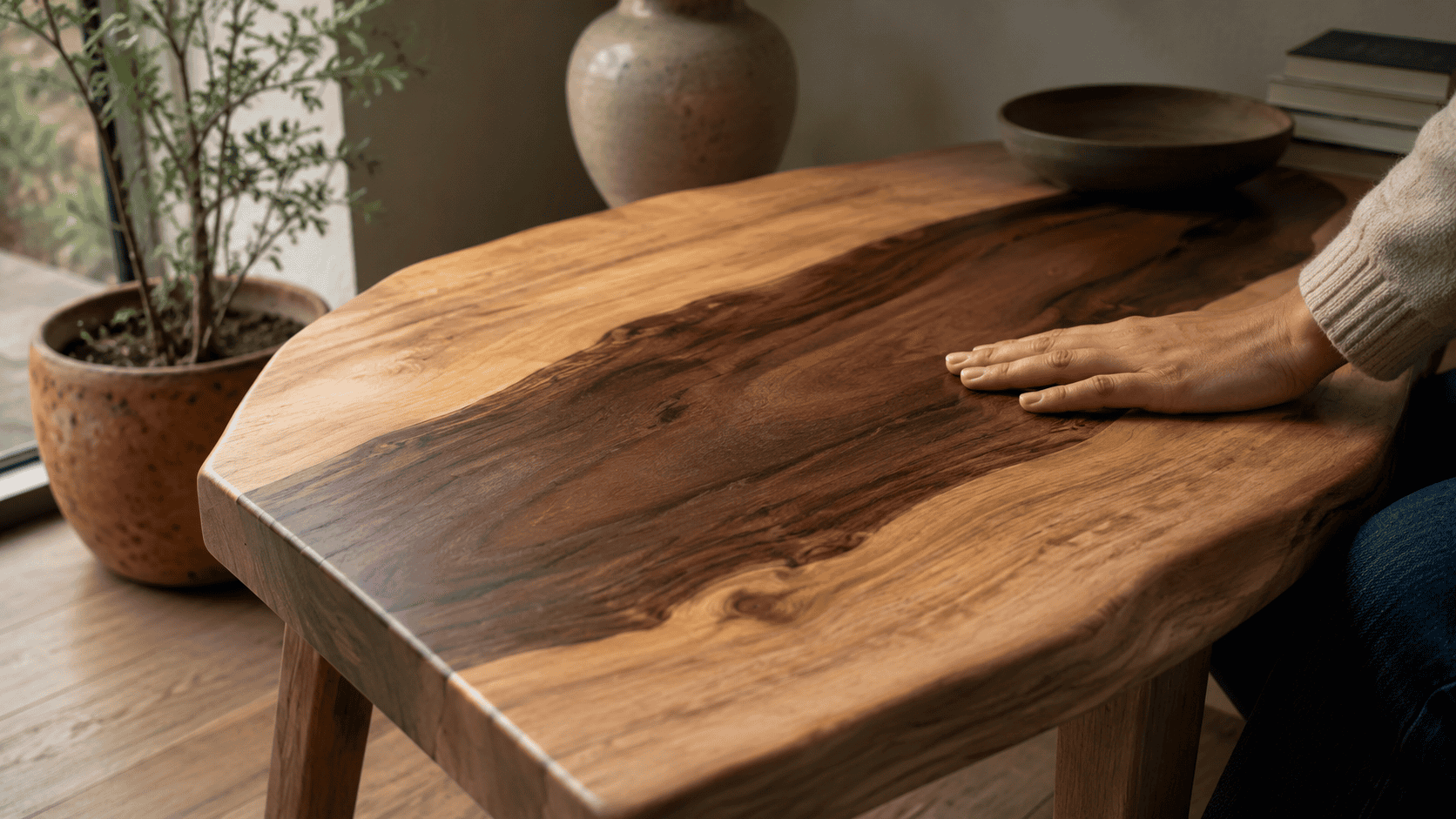
Every time my husband brings a fresh board into the shop, I notice something.
Part of it is pale. Part of it is darker, sometimes almost the color of coffee.
For a long time, I thought that color change was random.
It is not.
It is the tree’s own history, written directly into the wood.
Every tree trunk is made of two different kinds of wood. The outer band, closest to the bark, is called sapwood. The inner core is called heartwood.
They come from the same tree, but they were not doing the same job while the tree was alive, and they do not behave the same way once they become lumber.
Sapwood is the busy part.
While a tree is alive and growing, sapwood carries water up from the roots to the leaves. Think of it as the tree’s plumbing. It is active every day the tree is putting on new growth.
Heartwood is retired.
It sits at the center of the trunk and no longer carries water.
Here is the part I find beautiful: heartwood was once sapwood.
Every year, the tree grows a new ring of sapwood on the outside. At the same time, the oldest ring of sapwood near the center stops carrying water and slowly becomes heartwood instead.
The boundary between the two keeps moving outward, one ring at a time, throughout the life of the tree.
That change comes with a shift in color too.
As sapwood becomes heartwood, the tree deposits natural chemical compounds into it called extractives, according to research published by the U.S. Forest Service’s Forest Products Laboratory.
Extractives act as the tree’s own built-in preservative. They give heartwood its deeper, richer color. They also help it resist rot and insect damage more effectively than sapwood.
That matters if you build furniture, or even if you simply want something to last.
Heartwood is naturally more resistant to decay because of those extractives. Sapwood is younger and more active, but it has not developed the same protection. If it is left unfinished and exposed, it is more vulnerable to insects and rot over time.
There is a trade-off, though.
Heartwood is also less absorbent than sapwood, so it holds moisture differently and can take longer to dry properly during lumber processing. Sapwood tends to dry more quickly, but it often needs more care and finishing once a piece is built because it does not have the tree’s natural protection built in.
Some woods show this difference boldly.
Black walnut is a good example. Its heartwood may be a deep chocolate brown, while the sapwood beside it is almost cream-colored.
Other woods, like maple, may show very little contrast between the two.
That is one reason skilled woodworkers pay close attention to where a board was cut from the log. Matching the grain and color across a tabletop or a set of drawer fronts means noticing exactly where that line falls.
Here is what I love about all of this.
The plank sitting on my husband’s bench is not simply a piece of wood.
It is a record.
That pale band near the edge was still working, still carrying water, right up until the day the tree came down.
The darker heart at the center had already completed a long, quiet part of its life, protected years before the saw ever touched it.
Furniture makers understood this long before anyone used a word like “extractives.”
Heartwood is often chosen deliberately for the parts of a piece that need to endure the longest: legs, structural joints, and anything exposed to weather.
Sapwood is used too, but it is usually sealed and finished more carefully so it can hold its own beside its older, tougher neighbor.
The next time you run your hand across a wooden tabletop, look for that change in color.
That line between light and dark is not a flaw. It is not something that always needs to be hidden.
It is the tree telling you how it grew, one ring at a time.
I did not know any of this a year ago.
I still do not build the furniture. That is my husband’s gift, not mine.
But learning why that color change happens has made me look at every board differently.
It is not just material anymore.
It is a small biography, sitting right there beneath the finish.
Sources
- Differences between heartwood and sapwood — USDA Forest Service Research & Development
- USDA Forest Products Laboratory, “Differences Between Heartwood and Sapwood” (Forest Products Laboratory Report)
- Structure and Function of Wood — USDA Forest Products Laboratory
- Sapwood & Heartwood Differences — Wagner Meters
Deja un comentario