


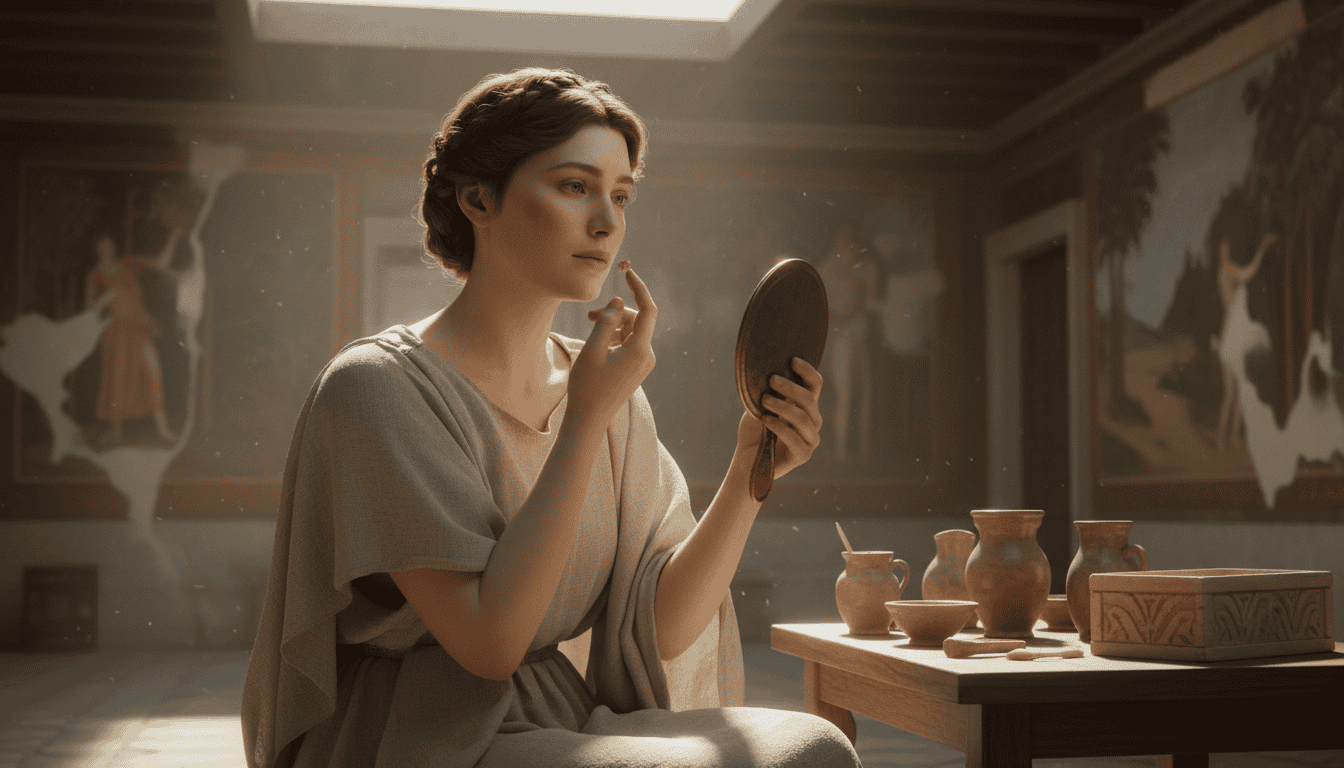
I have discovered something amusing about Roman beauty.
They admired pale complexions.
But apparently, not too pale.
A little color in the cheeks was useful.
Just enough to make the face look warm, lively, and perhaps a little embarrassed.
Except the woman may not have been embarrassed at all.
She may have simply been wearing rouge.
Ovid Understood the Advantage
Ovid includes a wonderfully telling line in one of his poems.
A natural blush can be attractive.
But an artificial blush has one enormous practical advantage.
You can choose when it appears.
I had to smile at that.
A genuine blush has no respect for timing.
It shows up when you are embarrassed, overheated, surprised, or standing somewhere wishing the floor would open.
Cosmetic color is much more cooperative.
Where Did the Red Come From?
The Roman world knew many red coloring materials.
Some came from plants.
Some came from minerals.
Ancient discussions mention materials such as alkanet and other red dyes, while Roman pigment technology also included red ochre, cinnabar, and red lead.
But here we need to be careful.
A pigment on a Roman wall is not automatically proof that somebody put it on her cheek.
We know artificial facial coloring existed.
We do not know that every red pigment had the same cosmetic use.
And I would much rather say that clearly than turn a wall-paint sample into a beauty recipe.
The Natural Look Is Not New
This is the part that feels very modern to me.
The desired effect was something nature already produces.
A flush.
We were not necessarily trying to look painted.
We were trying to look as though we were not painted.
Saludable.
Cálido.
Fresh.
Preferably with no visible evidence of the work involved.
I am beginning to think “effortless beauty” may be one of the oldest contradictions in cosmetics.
Old Idea, New Jar
I can understand this one. There are mornings when a little blush accomplishes more than a second cup of coffee, although I would still prefer both.
The Romans wanted the appearance of natural color. So do we. The jars changed. The idea did not.
Maybe the funniest thing about beauty history is how often the “new” look turns out to be very old indeed.
Deja un comentario