


We are deep into the middle of summer now, in the Fourteenth Week of Ordinary Time.
There is no great season of preparation surrounding us. We are not waiting through Advent or making our way through Lent. Ordinary Time can seem quieter than that. It is the season of continuing. Of remaining faithful. Of allowing God to work in us without needing every day to feel important.
Perhaps that is why Saint Kateri Tekakwitha feels so fitting for today.
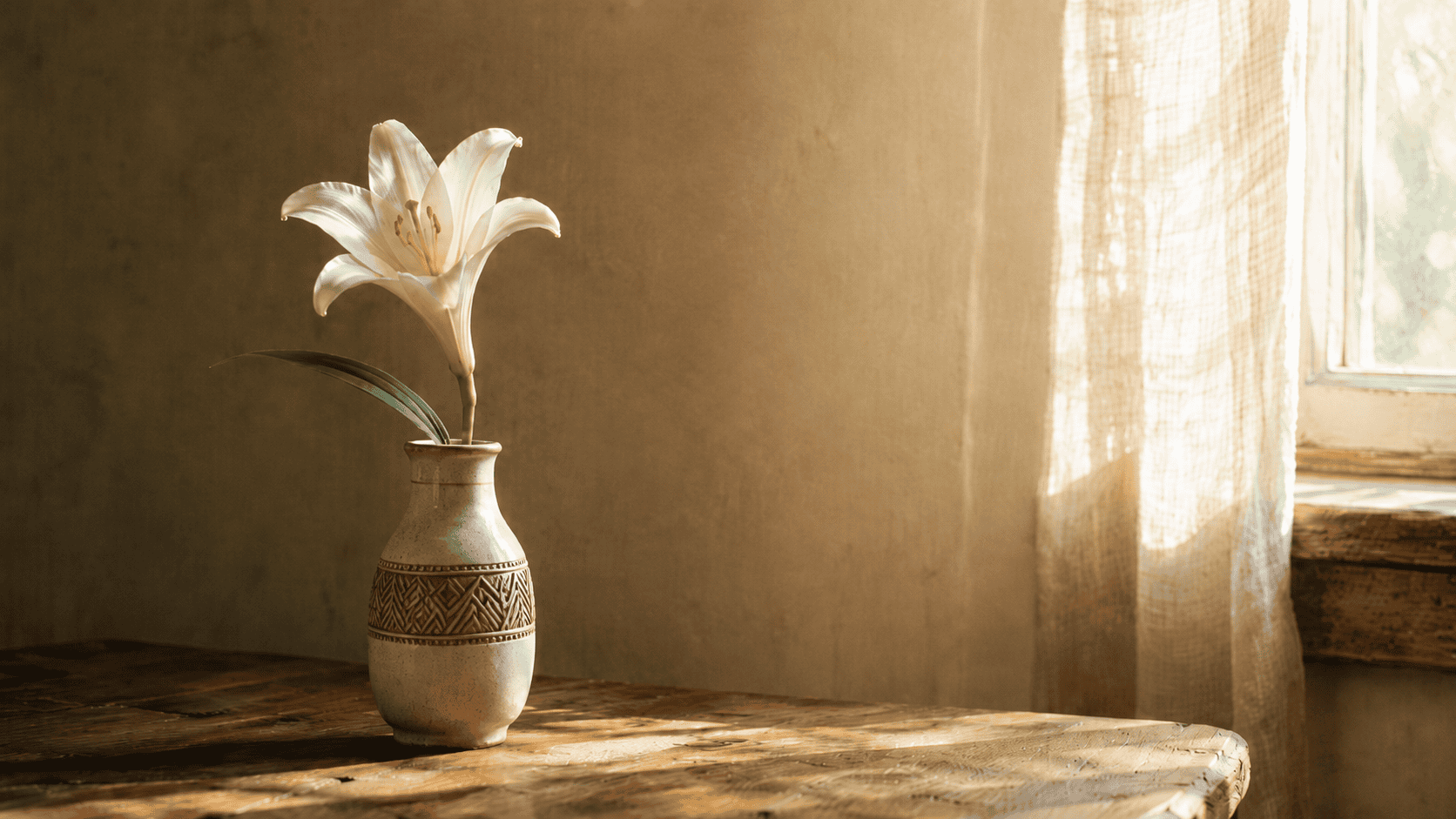
July 14 is her memorial. She is often called the “Lily of the Mohawks,” and she was the first Native American woman to be recognized as a saint by the Catholic Church. She was canonized in 2012, nearly four hundred years after her death.
Kateri was born in 1656 near what is now Auriesville, New York. Her father was a Mohawk chief, and her mother was a Christian Algonquin woman who had been taken captive when she was young.
When Kateri was only four years old, smallpox swept through her village. Her parents and baby brother died. Kateri survived, but the illness left her face scarred and her eyesight badly damaged.
She was raised by an uncle who strongly opposed the Jesuit missionaries, whom the Mohawk called the Blackrobes. Although a peace agreement required him to tolerate their presence, he did not want Kateri to become involved with them.
Still, she listened.
For years, she listened quietly. She was drawn to the faith, but she was afraid to ask openly for instruction.
She was nineteen before she was baptized. She received the name Catherine, which became Kateri in Mohawk speech, on Easter Sunday.
Her conversion cost her almost immediately.
Because she would not work on Sunday, she was punished and denied food. She was treated harshly by members of her family and village because of her faith. Eventually, with the encouragement of a priest, she fled nearly two hundred miles to a Christian settlement near Montreal.
There, during the last few years of her life, Kateri gave herself more fully to prayer.
She fasted. She practiced penance. She cared for others. She continued trying to live faithfully, even when that faithfulness was not understood.
At twenty-three, she made a vow of virginity. It was an unusual choice within her culture, where marriage was closely tied to a woman’s security and place in the community.
Kateri and two friends also hoped to begin a religious community of their own. The priest overseeing the settlement did not believe they were ready and encouraged them to remain within the ordinary life of the mission.
So Kateri remained.
She prayed. She served. She continued living the life placed before her.
She died at only twenty-four years old, on the afternoon before Holy Thursday.
Her life had been short. Much of it had been difficult. Outside the small circle of people who knew her, very few would have considered her life important.
Yet after her death, something happened that those present never forgot.
Father Claude Chauchetière, the priest who was there, wrote that within minutes the scars and marks left by smallpox seemed to disappear from her face. Her features became smooth and peaceful. Those around her believed they were seeing outwardly what had been forming within her for years.
Her final words were recorded as:
“Jesus, Mary, I love you.”
As I read her story, I could not help but think about the phrase behind All About You:
Complete beauty, inside out.
Kateri never heard those words, of course. Yet there is something in her life that reflects them.
For most of her life, the world would not have called her beautiful. Her face had been marked by illness. Her body had been weakened by suffering. Her faith was misunderstood. Much of what she did was hidden from anyone beyond the people closest to her.
Yet something was being formed within her.
Scripture speaks of this kind of beauty:
“Let not yours be the outward adorning with braiding of hair, decoration of gold, and wearing of fine clothing, but let it be the hidden person of the heart with the imperishable jewel of a gentle and quiet spirit, which in God’s sight is very precious”
(1 Peter 3:3–4, RSV-2CE).
I do not believe Peter was saying that outward beauty has no value.
He was reminding us that outward beauty is not the whole of us.
There is another kind of beauty, one that cannot be measured by appearance alone. It is formed quietly. It grows through faithfulness, endurance, humility, prayer, and the daily decision to keep turning toward God.
It is the beauty of the hidden person of the heart.
Perhaps that is what Saint Kateri’s life asks us to consider today.
There may be work happening in your life that no one else can see.
It may be a prayer life that feels small and unnoticed.
It may be something you have written and rewritten, but still do not feel ready to share.
It may be the hours spent shaping a piece of furniture before anyone sees the finished work.
It may be soap curing quietly on a shelf for six weeks, while nothing about it appears to be changing.
We often admire the finished thing and forget how much of its formation happened out of sight.
Kateri’s life was much the same.
For years, she listened before she could speak openly.
She believed before she could safely act.
She remained faithful when faithfulness cost her something.
Most of that growth happened where very few people could see it.
But hidden growth is still growth.
The fact that no one notices does not make it less real. The fact that it takes time does not mean nothing is happening.
Sometimes the most important work God does in us is the work no one else can see.
Perhaps that is the invitation for this Tuesday in July.
Do not rush past the quiet part.
Do not assume that the work is unimportant simply because it is not yet visible.
Whatever patient thing God is forming in you, whether through prayer, through your craft, through suffering, or simply through the daily choice to remain faithful, allow it the time it needs.
Not everything holy announces itself while it is being formed.
Sometimes it grows quietly beneath the surface, known only to God.
And perhaps that is where complete beauty, inside out, has always begun.
Deja un comentario