


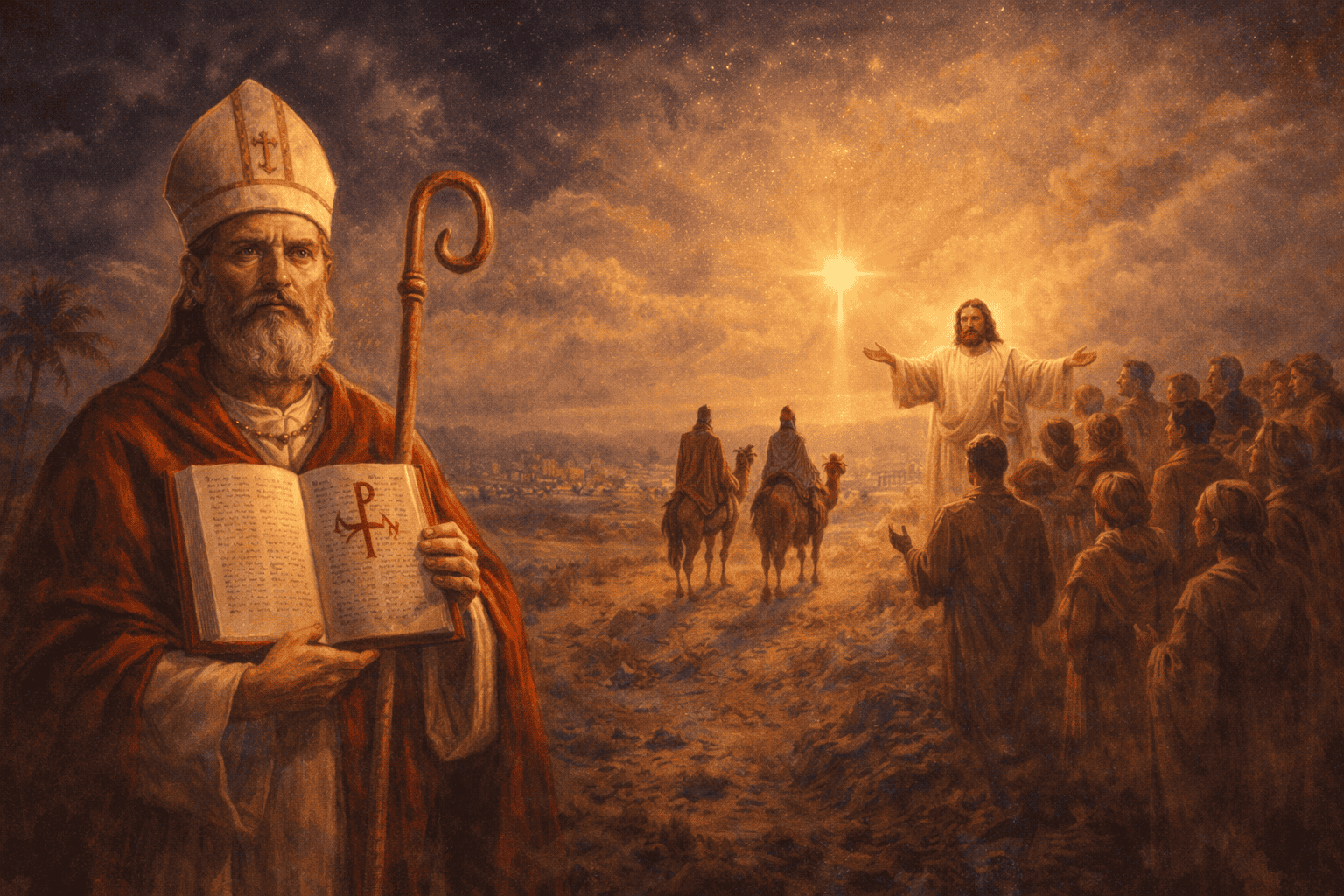
Padre de la Iglesia primitiva: San Ireneo de Lyon (c. 130-202 d. C.)
Ireneo vivió en un mundo que sentía fracturado.
Diferentes enseñanzas competían por captar la atención. Diferentes voces afirmaban hablar en nombre de la verdad. La gente no sabía qué conservar y qué dejar ir.
Y en medio de esa confusión, Ireneo seguía volviendo a una convicción simple y firme:
Cristo vino a reunir lo que había sido esparcido.
No abandonar el mundo.
No empezar de cero con algo nuevo.
Sino tomar la vida humana misma y sanarla desde dentro.
Esto es lo que la teología posterior llamaría "recapitulación", pero la idea en sí no es complicada.
Lo que estaba roto se recoge y se restaura.
Lo que estaba dividido, vuelve a unirse.
Lo que se perdió no se desecha, sino que se redime.
Para Ireneo, la Epifanía no se trata solo de revelación. Se trata de reunión.
Cristo no se presenta como un extraño para la humanidad. Se presenta como alguien que pertenece a ella. Comparte nuestra naturaleza, nuestra debilidad, nuestro crecimiento, nuestra mortalidad, de modo que nada humano queda fuera de su obra salvadora.
Al hacerse visible, Dios no se sitúa por encima de nosotros.
Él está con nosotros.
Y eso lo cambia todo.
Ireneo suele hablar de Cristo como quien recorre los pasos de la humanidad, tomando nuestra historia y redirigiéndola hacia la vida. Donde antes la desobediencia conducía a la pérdida, ahora la obediencia conduce a la restauración. Donde antes el miedo nos dispersaba, ahora el amor nos une.
Desde esta perspectiva, la Epifanía no solo revela quién es Cristo, sino también en qué se inspira a la humanidad.
Entero.
Sanado.
Reunidos.
Esta forma de ver la fe tiene una fuerza serena.
Significa que la salvación no consiste en escapar de la condición humana.
Se trata de recuperar la plena condición humana.
Nuestros cuerpos importan.
Nuestras historias importan.
Nuestras relaciones importan.
Nada se desperdicia. Nada se ignora.
Cristo no pasa por alto la vida humana. Él la recoge.
Y quizás por eso la Epifanía sigue transmitiendo esperanza, incluso cuando el mundo parece dividido.
Porque nos dice que la respuesta de Dios a la fragmentación no es el abandono, sino la unión. No el retiro, sino la presencia. No la separación, sino la reunión.
No estamos destinados a permanecer dispersos.
Estamos llamados a regresar a la plenitud, a la comunión, a una vida que no tiene fin.
En la visión de Ireneo, Cristo no es solo la luz que revela, sino el centro que sostiene.
Aquel que reúne todas las cosas en sí mismo.
Y eso significa que la Epifanía no se trata solo de ver.
Se trata de pertenecer.
Fuentes y referencias
Sagrada Escritura
- Juan 1:1–14
- Efesios 1:9–10
Padre de la Iglesia Primitiva
- San Ireneo de Lyon, Contra las herejías, Libro III
San Ireneo de Lyon – Nuevo Adviento
Lecturas
- Epifanía: La luz se revela
- Luz prometida
- La Palabra hecha visible
- Una luz destinada a todas las naciones.
- Reunidos en uno solo
- Próximamente: Cuando la Creación Da Testimonio
Deja un comentario