
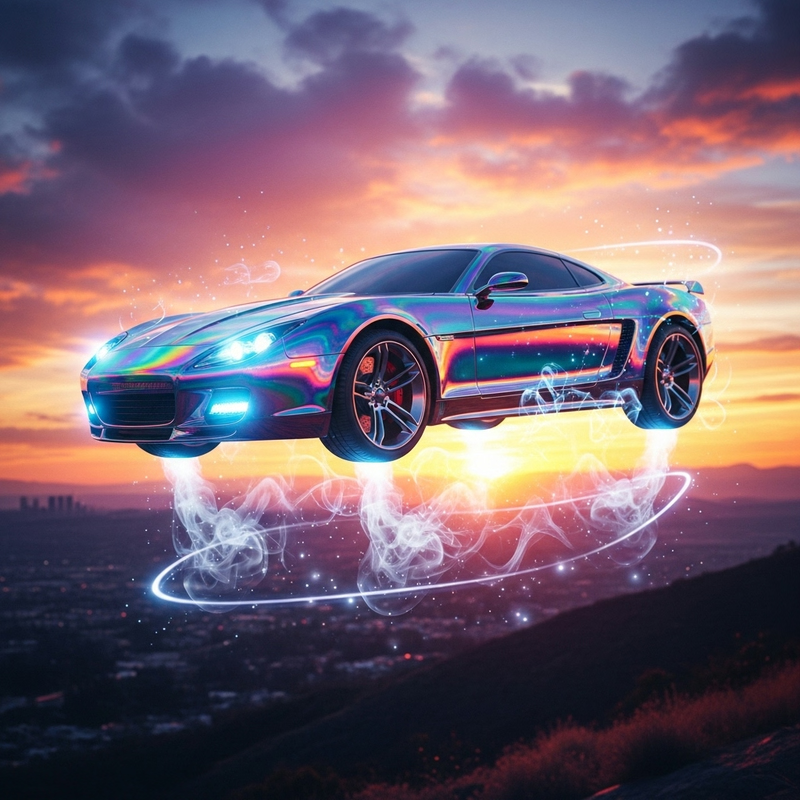
I remember back when I was a young kid staying up late to watch a show with KITT from Knight Rider.
KITT was an awesome car. Not just because he was sleek or fast—but because he knew things. He could talk, think, protect, reason, and occasionally question the driver’s choices (which, honestly, felt pretty wise even back then).
That car could do so many things.
So if someone asked me today, What would be your all-time favorite car?
I know exactly what it wouldn’t be.
It wouldn’t be anything made today.
I wouldn’t want a car that’s just faster, shinier, or buried under menus and software updates. I’d want a car that could do many of the things KITT did—but with personality. A classic car with personality, not a touchscreen on wheels.
And if I’m really honest, I’d want a button I could press where the car could change. Not just modes—form. One day it’s a classic cruiser. Another day it leans quietly futuristic. Maybe even a little George Jetson–style… practical, lighthearted, and slightly ahead of its time.
A Car with Personality, Not a Touchscreen
Now, here’s where my idea really parts ways with modern tech.
I wouldn’t want chips implanted anywhere.
No neural links.
No syncing my brain to a dashboard.
Instead, I imagine something much simpler—and somehow more elegant.
You wouldn’t tell the car where to go.
You’d transmit it.
Not through a chip, but through something more like a Nikola Tesla–style transmission—energy, frequency, intention. You’d rest your hand on the wheel, think of the place you want to be, and the car would quietly acknowledge it. No beeping. No flashing alerts.
Just a soft confirmation… and then motion.
And the best part?
You could actually work on the car.
Pop the hood and you’d see real parts. Real craftsmanship. Wires you could trace. Dials you could adjust. No sealed systems warning “authorized service only.” This would be the kind of classic car with personality that guys who love engines would admire—the ones who appreciate metal, sound, balance, and the smell of oil and polish.
From the outside, it would look timeless.
From the inside, quietly brilliant.
And of course, the car would talk.

Sometimes I imagine the exchange going like this:
Me: “Alright, let’s go.”
Car: pause “You don’t actually know where you’re going, do you?”
Me: “I have a general idea.”
Car: “You said that last time. We ended up at a bookstore and a coffee shop.”
Me: “Those were good decisions.”
Car: “I did not object.”
Then I’d reach over and press the button.
Car: “You are not switching modes just because you’re feeling nostalgic.”
Me: “Classic mode feels right today.”
Car: “Very well. Slower acceleration. Better music. And may I remind you—this road prefers patience.”
Honestly, I’d trust that kind of car.
It wouldn’t rush.
It wouldn’t nag.
It would just… know when to speak.
I’ve written before about how journeys shape us in quiet ways, and this idea feels like a continuation of that reflection.
And maybe that’s why cars like KITT stayed with us for so long.
They were never really about technology.
They were about companionship on the journey.
If I had my ideal car, it wouldn’t be the newest or the loudest. It would be something timeless—something you could understand, care for, and grow familiar with. A classic car with personality that honors the past, moves thoughtfully through the present, and doesn’t demand we merge with machines to get where we’re going.
Just a wheel.
A road.
A quiet understanding.
And maybe—every once in a while—a gentle reminder from the car itself:
“You’re exactly where you need to be.”


Responder a myallaboutyouCancelar respuesta