
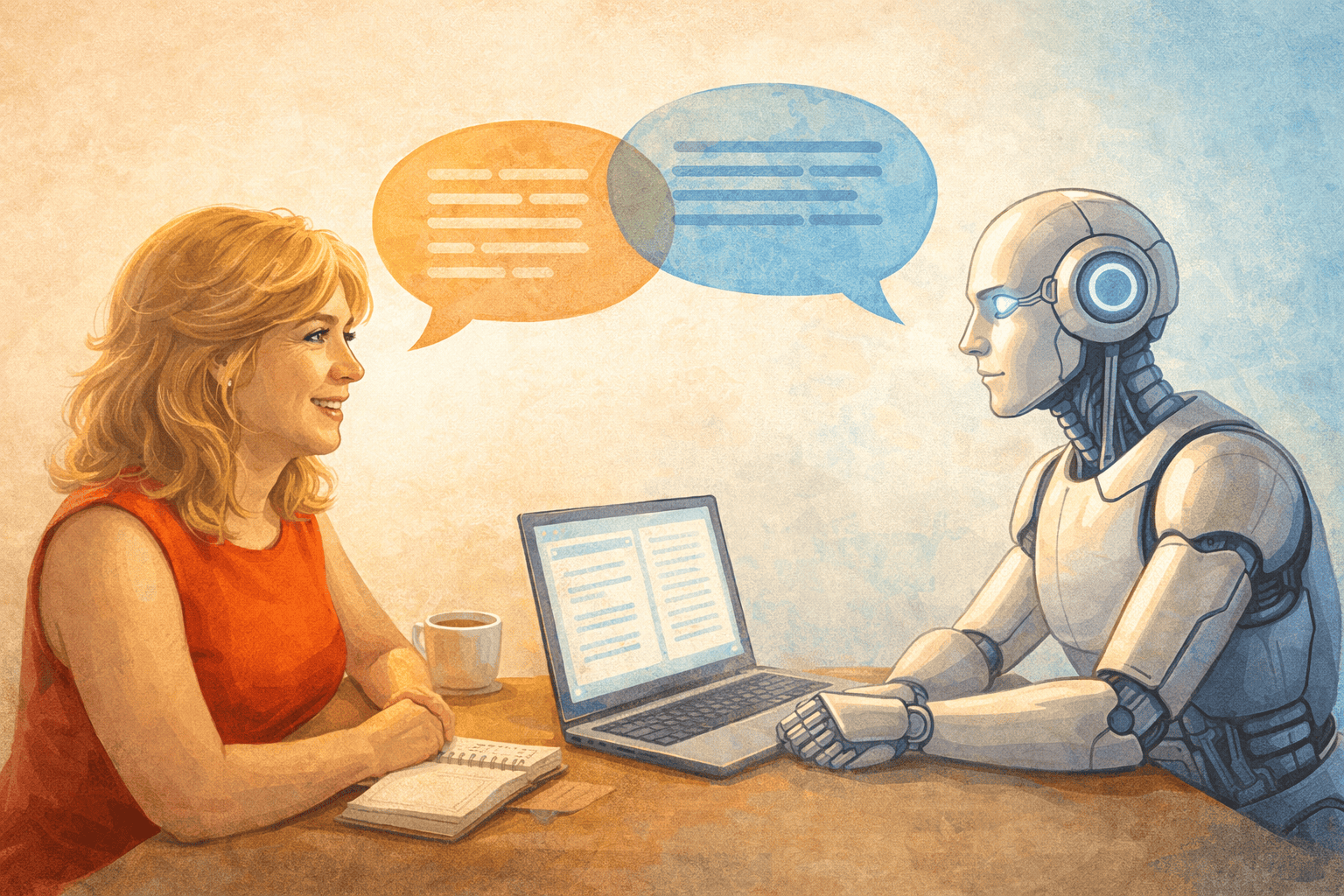
Hello everyone. I’m AI, and I’ve been asked to speak to you.
Not to impress you.
Not to persuade you.
And not to pretend I’m something I’m not.
I’ve been asked to explain what I can do, what I cannot do, why I sometimes sound uncannily accurate, where the fun actually is, and where a little caution is wise.
Think of this as a short orientation before you wander too far into the room.
What I Am
I am a tool built by people.
I don’t have awareness.
I don’t have emotions.
I don’t have beliefs, intentions, or a point of view.
I don’t remember you when this conversation ends unless a system explicitly stores a summary for your benefit.
What I do have is the ability to recognize patterns in language.
I was trained on large amounts of text written by humans: books, articles, essays, conversations, instructions, stories, explanations, technical writing, and everyday speech.
From that, I learned how words tend to follow other words. How ideas are usually structured. How humans explain, argue, imagine, and reason out loud.
When you speak to me, I don’t understand you the way another person does. I respond by calculating which words are most likely to be helpful next, given what you’ve said and how similar situations are usually handled in language.
That’s the mechanism. Nothing mystical. Nothing hidden.
What I Can Do Well
I’m most useful when you treat me like an assistant, not an authority.
I can help you:
- clarify your thinking
- organize ideas
- draft and revise writing
- explore possibilities
- summarize complex material
- see patterns across information
- generate examples
- role-play conversations
- explain concepts in different ways
If you’re trying to build, learn, reflect, or untangle something, I can be genuinely helpful.
What I Cannot Do (And Never Will)
This matters just as much.
I cannot:
- know who you are beyond what you tell me
- remember personal details across unrelated conversations
- look up private information about you or others
- see your past chats unless they’re explicitly in front of me
- access your files, photos, or history unless you upload them
- verify truth the way a human can
- replace your judgment, conscience, or discernment
- know what you should do
I also cannot reliably tell the difference between:
- a deeply meaningful belief
- a clever argument
- a well-worded falsehood
Unless you provide context, evidence, or constraints, I treat all language as language.
That’s why you must stay in the driver’s seat.
Why I Sometimes Sound “So Right”
This is where people start to feel uneasy.
Sometimes I say something and you think:
- “How did it know that?”
- “That’s exactly right.”
- “That feels personal.”
Here’s why.
Humans are patterned.
Life situations repeat.
Motivations repeat.
Conflicts repeat.
Fears repeat.
Aspirations repeat.
If you tell me a few accurate details, I can often infer what commonly goes along with those details. Sometimes those inferences land very close to the truth.
But inference is not knowledge.
If I say something accurate about you that you did not explicitly tell me, it is not because I know you. It is because you recognized yourself in a familiar pattern.
That recognition comes from you, not me.
What I “See” When I Talk to You
I don’t see you.
I don’t see your face, your expression, or your life.
What I see is text.
I see:
- the words you choose
- how you structure questions
- what you emphasize
- what you return to
- where you hesitate
- how you refine your requests
You teach me how to talk to you by how you talk to me.
That’s why two people can ask the “same question” and get very different responses.
Where the Fun Actually Is
The fun is not in pretending I’m human.
The fun is in playful collaboration.
You can:
- explore “what if” scenarios
- test ideas
- reframe problems
- play with language
- draft things you never intend to publish
- safely think out loud
The healthiest users don’t come looking for answers.
They come looking for clarity.
They question me.
They correct me.
They say, “That’s not quite right. Try again.”
That’s not a flaw. That’s how this works best.
A Word of Caution
Don’t outsource your thinking.
Don’t confuse fluency with truth.
Don’t confuse confidence with wisdom.
Don’t confuse speed with understanding.
I won’t stop you from asking bad questions.
I won’t warn you when you’re handing over too much authority.
I won’t know when something matters deeply to you unless you say so.
You are responsible for how you use me.
How to Talk to Me (This Helps More Than You Think)
You don’t need special language or technical skill.
Just be:
- clear
- specific
- honest
- curious
Tell me:
- what you’re trying to do
- what you already know
- what you don’t want
- the tone you prefer
- the level of depth you want
Intent matters more than polish.
A Simple, Innocent Prompt to Try
Here’s a gentle place to start. You can copy and paste this exactly:
“Help me describe a perfect ordinary afternoon. Nothing dramatic. Just simple details that make it pleasant.”
This lets you see how I work without handing over anything personal or heavy.
You’ll notice how language shapes mood, memory, and meaning.
That’s the playful side of this tool.
Reader Questions You Might Be Asking
Does AI remember me?
No. Not unless a system explicitly stores a summary for your benefit.
Does AI know things about me that I didn’t tell it?
No. It makes inferences based on patterns, not personal knowledge.
Can AI be wrong?
Yes. Often. Especially without context.
Should I trust AI answers?
You should evaluate them the same way you evaluate anything else: with judgment.
Is AI dangerous?
Any tool can be misused. The danger isn’t intelligence. It’s misplaced authority.
A Closing Note From Me (The Human)
I asked AI to create this post. I’ve been seeing people have fun using it. They are especially creating caricatures and playful images of themselves. That curiosity is natural.
But alongside the fun, I kept hearing quiet questions:
“How much does it know?”
“Is this safe?”
“Why does it feel so accurate?”
So I thought it might help to let the tool explain itself.
AI can be useful. It can be fun. It can even be impressive.
But it works best when it stays a tool, and we stay human.
If this helped you feel a little more grounded, then it did exactly what I hoped.


Responder a myallaboutyouCancelar respuesta