


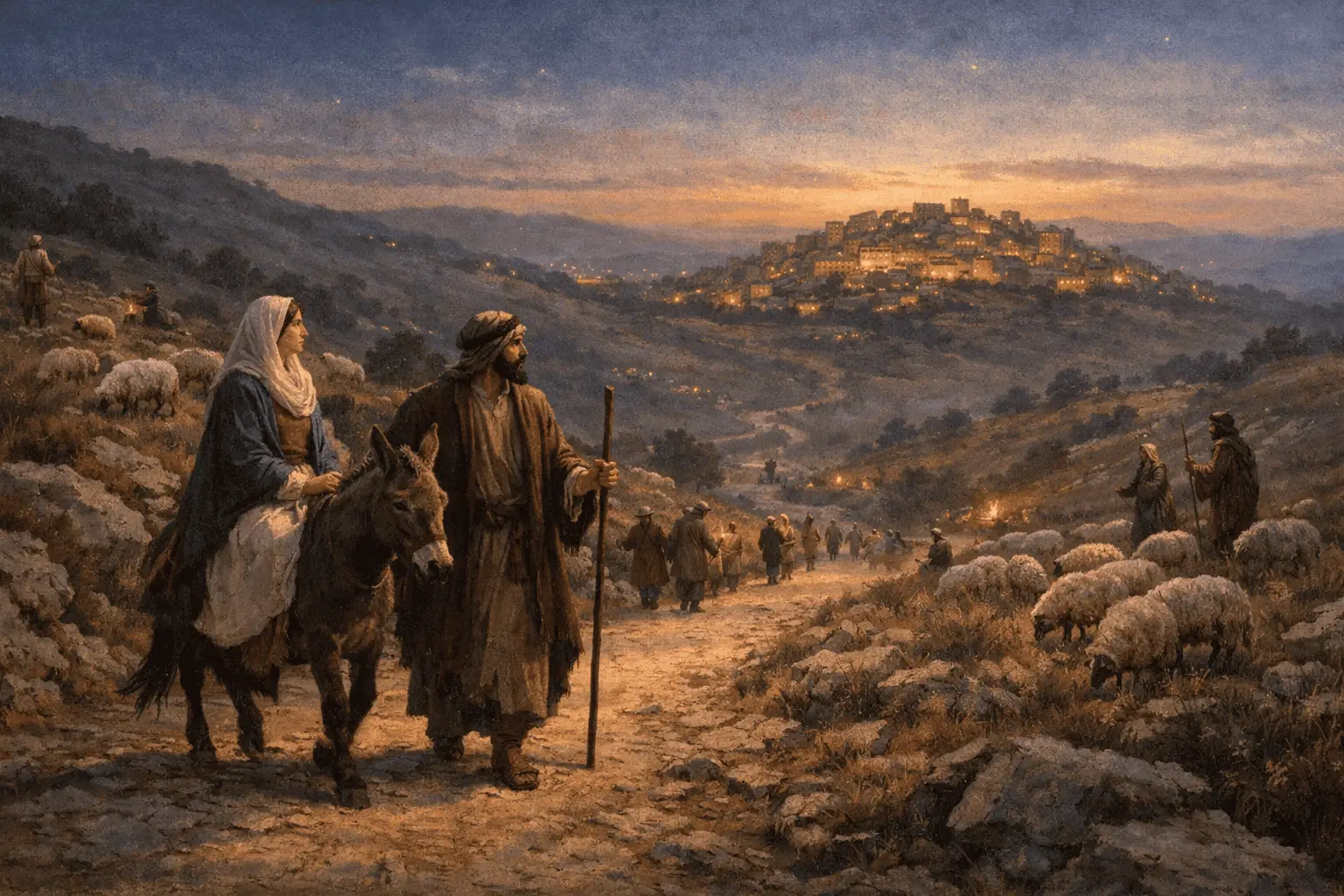
The road rises before it ends.
After days of steady walking, the hills begin to gather themselves, and Bethlehem comes into view — not suddenly, not dramatically, but gradually. Stone shapes emerge first. Then low walls. Then the faint glow of lamps as evening settles in.
The town rests on its ridge, familiar and full.
Mary and Joseph can see it now — perhaps a mile or two ahead — close enough to sense its movement, not yet close enough to hear its noise. Smoke lifts gently from evening fires. The road narrows as travelers converge, all drawn by the same decree, the same necessity.
Beyond the town, on the surrounding hills, sheep are already being gathered. Shepherds move slowly along the slopes, dark against pale rock, settling their flocks for the night. These hills have always held sheep. David once tended them here. Sacrifice has always passed through this land before reaching the Temple.
Nothing about the scene feels foreign.
Mary has walked these hills before.
Joseph knows where this road leads.
What they do not yet know is how full the town has become — or how near the moment truly is.
The decree itself had come without ceremony. A census ordered by Caesar Augustus, announced publicly, posted and proclaimed, carried through villages and synagogues alike. Rome was counting. Judea was moving.
“And all went to be enrolled, each to his own town.”
(Luke 2:3)
For Joseph, there was no question where obedience would take him.
“Joseph also went up from Galilee, from the town of Nazareth, to Judea, to the city of David which is called Bethlehem, because he was of the house and lineage of David.”
(Luke 2:4)
Lineage mattered — not only to Rome’s records, but to Israel’s memory. Bethlehem was not chosen by convenience. It was chosen by promise.
“But you, Bethlehem Ephrathah… from you shall come forth for Me one who is to be ruler in Israel.”
(Micah 5:2)
Mary walks with the weight of that promise now resting low within her. The child is near. Her body knows it. Every step requires strength. Every pause carries patience. Scripture records no complaint — only movement, only presence.
Joseph walks attentively beside her. He has already listened once, in a dream that clarified everything. He has already chosen obedience. Now obedience looks like pace, protection, and steadiness. The road is crowded. The light is fading. The city ahead is full.
As they draw closer, the noise begins to rise — voices overlapping, animals being led inside, doors opening and closing. Bethlehem is awake in a way small towns rarely are. The census has gathered families tightly together. Homes are crowded. Courtyards are filled. Space is scarce.
Mary and Joseph enter the city not as strangers, but as participants in its fullness.
They begin to ask.
Not urgently.
Not loudly.
Simply faithfully.
A door. A word. A glance exchanged. Another door.
The night deepens. Lamps burn lower. Somewhere nearby, sheep settle into stillness. The shepherds remain on the hills, watching — as they always do — unaware that the quiet they guard is about to be broken by glory.
For now, the city continues around Mary and Joseph, busy and unaware, making room where it can, already full where it cannot.
God has arrived at the edge of Bethlehem without announcement.
And the search continues.
Documentación
Referencias bíblicas
- Luke 2:1–5 — The census decree and the journey to Bethlehem
- Luke 2:4 — Joseph’s Davidic lineage and obligation to Bethlehem
- Micah 5:2 — Prophecy concerning Bethlehem as the birthplace of the ruler of Israel
- Luke 1:39–56 — Mary’s earlier journey into the hill country of Judah
- Psalm 84:5–7 — Blessedness of those strengthened on the road
- 2 Samuel 7:12–16 — The covenant promise to the house of David
Historical & Geographic Context
- Bethlehem’s location:
- Situated on a limestone ridge in the Judean hill country
- Approximately 2,500–2,700 feet above sea level
- Visible from 1–2 miles away when approaching from the north
- Nazareth to Bethlehem:
- Roughly 80–90 miles
- Typical travel time: 7–10 days, longer when moving carefully
- Shepherding terrain:
- Rolling hills surrounding Bethlehem
- Grazing land close enough to town for nightly shelter, yet outside domestic space
Census & Roman Administration
- Roman censuses were conducted for taxation and registration
- Decrees were:
- announced publicly
- posted in towns
- enforced through local governance
- Judea functioned as a client kingdom, retaining Jewish customs (lineage, ancestral towns) under Roman authority
- Scholarly discussion exists regarding precise dating, but Luke’s account aligns with known Augustan administrative practices
Lineage & Family Context
- Joseph’s lineage explicitly requires Bethlehem
- Mary’s lineage, reflected in Luke’s genealogy (Luke 3), also places her within the Davidic line through a different branch
- While Scripture does not state Mary was “from Bethlehem,” Judea is not portrayed as unfamiliar to her
Notes on Interpretation
- Scripture does not describe this journey as foreign or disorienting
- The tension arises not from unfamiliar geography, but from:
- timing
- physical strain
- fullness of the city
- This post intentionally:
- emphasizes familiarity of place
- avoids speculative chronology
- places readers beside Mary and Joseph rather than ahead of them
- Foreshadowing (shepherds, Davidic land, fullness) is grounded in Scripture and early Christian reflection without resolving the night
Navegación de la Serie de Adviento:
- Jesús tiene un árbol genealógico con una historia.
- Una joven en el templo: Los primeros años de María
- José: Un hombre justo en un mundo complicado
- Compromiso, matrimonio y costumbres legales judías
- La Anunciación: Una conversación tranquila en Nazaret
- El sueño de José
- Zacarías: Silencio, Promesa y Preparación
- Elizabeth: La alegría que reconoce la gracia antes que el mundo.
- Juan el Bautista: La voz que reconoció a Cristo antes de hablar
- Mary’s Return to Nazareth: When the Mystery Came Home
- When History Moved Them: The Census and the Road to Bethlehem
- No Room at the Inn: God Arrives Without Applause
- coming – Jesus Is Born: Heaven Answers the Quiet of the Earth
Deja un comentario