


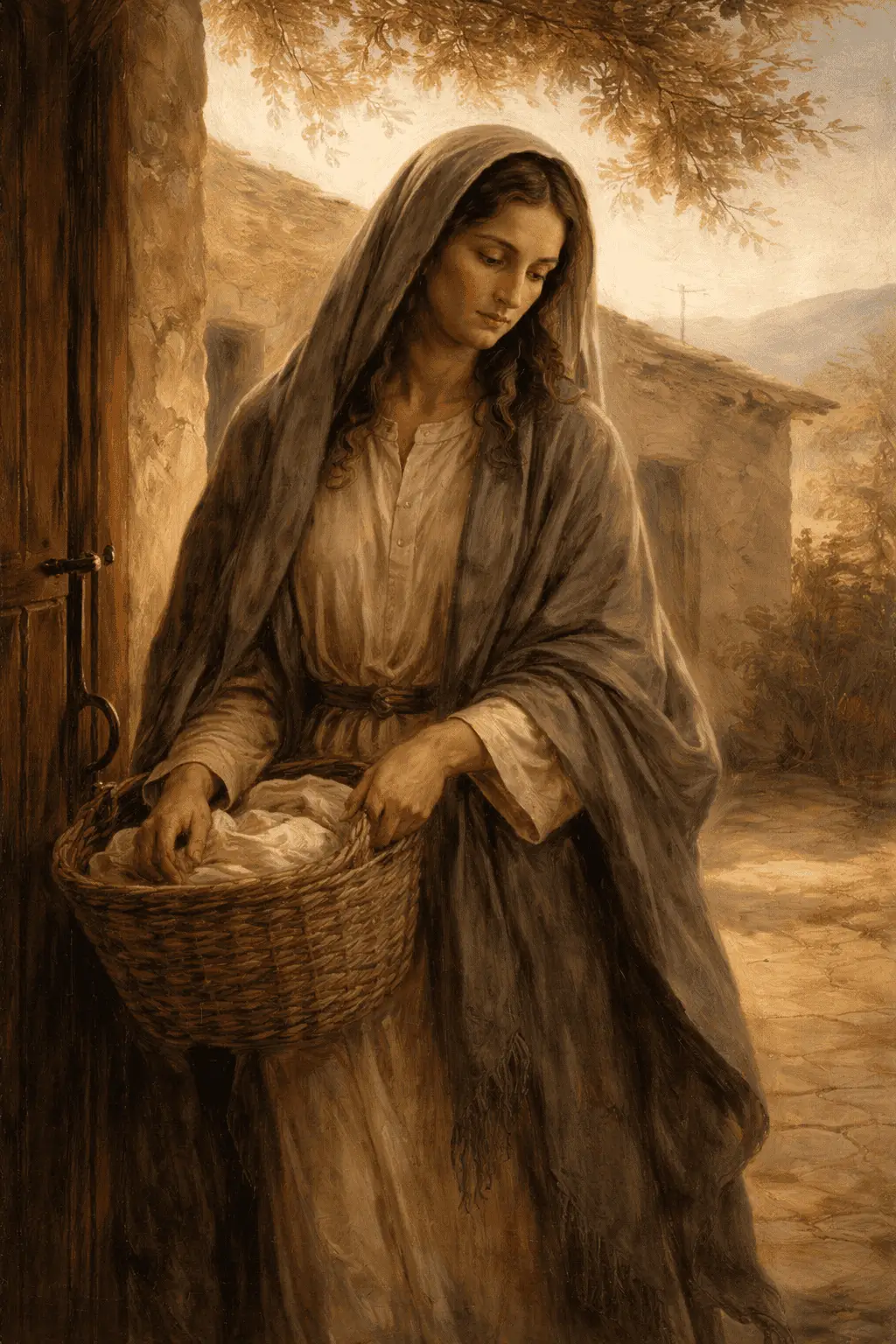
Mary does not remain in the hill country forever.
Luke tells us, simply and quietly:
“Mary remained with her about three months and then returned to her home.”
Luke 1:56
There is no commentary.
No description of the journey.
No record of her thoughts.
Scripture allows the moment to pass in silence.
But this return matters.
Because grace does not stay hidden forever.
Eventually, the mystery must come home.
Leaving the Hill Country
Mary has spent months in a place of recognition and joy.
Elizabeth welcomed her.
John leapt in the womb.
The Spirit spoke clearly.
The Magnificat rose freely.
In the hill country, Mary was known.
She was believed.
She was named blessed.
Nazareth will be different.
Returning home means returning to ordinary life—
to familiar streets, familiar faces, and familiar expectations.
It means carrying the Incarnation into a world that does not yet understand it.
The Weight of a Visible Mystery
Luke tells us nothing about the journey itself, but Matthew gives us the next quiet detail:
“When his mother Mary had been betrothed to Joseph, before they lived together, she was found to be with child.”
Matthew 1:18
Mary does not announce.
She does not defend.
She does not explain.
She returns.
And the mystery she carries is no longer only interior.
It is visible.
Nazareth is not a private culture.
It is a village.
People notice.
People talk.
People assume.
And Mary walks back into that space with the same quiet fidelity with which she left it.
Silence as Fidelity
Scripture does not record Mary speaking again until much later.
She does not argue.
She does not persuade.
She does not attempt to manage perception.
She entrusts herself—and the Child she carries—to God.
This is not passivity.
It is faith.
Mary’s yes at the Annunciation did not end when Gabriel departed.
It continues here, in the ordinary days that follow the extraordinary moment.
Faith is no longer spoken.
It is lived.
When Grace Enters the Ordinary
Nazareth represents the ordinary world.
Work.
Routine.
Expectation.
Unspoken rules.
This is where grace now dwells.
Not in the glow of angelic light,
but in daily life.
Mary’s return teaches us something essential about the Incarnation:
God does not remain in moments of recognition alone.
He enters homes.
Villages.
Conversations.
Silences.
The mystery comes home.
A Turning Point Without Words
This return marks a turning point in the story.
What began in silence in Nazareth at the Annunciation now returns there transformed.
What was once hidden in Mary’s heart is now visible to others.
And yet, Scripture does not dramatize this moment.
There is no confrontation recorded.
No explanation offered.
Only this quiet truth:
Mary comes home faithful.
An Advent Invitation
Mary’s return invites us to consider a difficult question:
What does it mean to carry God’s work back into ordinary life?
Many of us recognize grace in moments of clarity—
in prayer, retreat, or understanding.
But Advent asks something deeper.
Can we remain faithful when recognition fades?
When explanation is absent?
When the mystery is seen but not yet understood?
Mary shows us that holiness does not depend on being believed.
It depends on being faithful.
Grace does not need to be defended to be real.
It only needs to be carried.
Preparing the Way
Mary’s return does not resolve the tension.
It deepens it.
The mystery has come home.
And now, another heart will need to listen.
Another discernment will unfold.
Another quiet obedience will be asked.
But for tonight, Scripture leaves us here—
at the moment when grace enters ordinary life
and waits.
DOCUMENTATION
(Place at the bottom of the post as you do with the others)
Referencias bíblicas
- Luke 1:56 — Mary returns to her home after the Visitation
- Matthew 1:18 — Mary is found to be with child before living with Joseph
- Luke 1:38 — Mary’s fiat continues beyond the Annunciation
- Luke 2:19 — Mary keeps and ponders events in her heart
- Isaiah 7:14 — The sign of the Virgin bearing a son
Jewish & Cultural Context
- Nazareth as a small village where family life was communal and visible
- Betrothal (erusin) as a legally binding covenant prior to shared household
- The social weight carried by a woman returning home pregnant during betrothal
- Silence and restraint as expressions of faithfulness rather than passivity
Temas teológicos
- Grace moving from recognition into ordinary life
- Fidelity without explanation
- The Incarnation entering daily human experience
- Holiness sustained through silence and trust
Reflexión cristiana primitiva
- Mary’s continued fiat as lived obedience, not a single moment
- Mary as model of faith carried quietly into the world
- Silence as a form of assent and trust in God’s unfolding plan
(reflected in patristic readings of Luke by Ambrose and Augustine)
Navegación de la Serie de Adviento:
- Jesús tiene un árbol genealógico con una historia.
- Una joven en el templo: Los primeros años de María
- José: Un hombre justo en un mundo complicado
- Compromiso, matrimonio y costumbres legales judías
- La Anunciación: Una conversación tranquila en Nazaret
- El sueño de José
- Zacarías: Silencio, Promesa y Preparación
- Elizabeth: La alegría que reconoce la gracia antes que el mundo.
- Juan el Bautista: La voz que reconoció a Cristo antes de hablar
- Mary’s Return to Nazareth: When the Mystery Came Home
- coming – No Room at the Inn: God Arrives Without Applause

Deja un comentario