
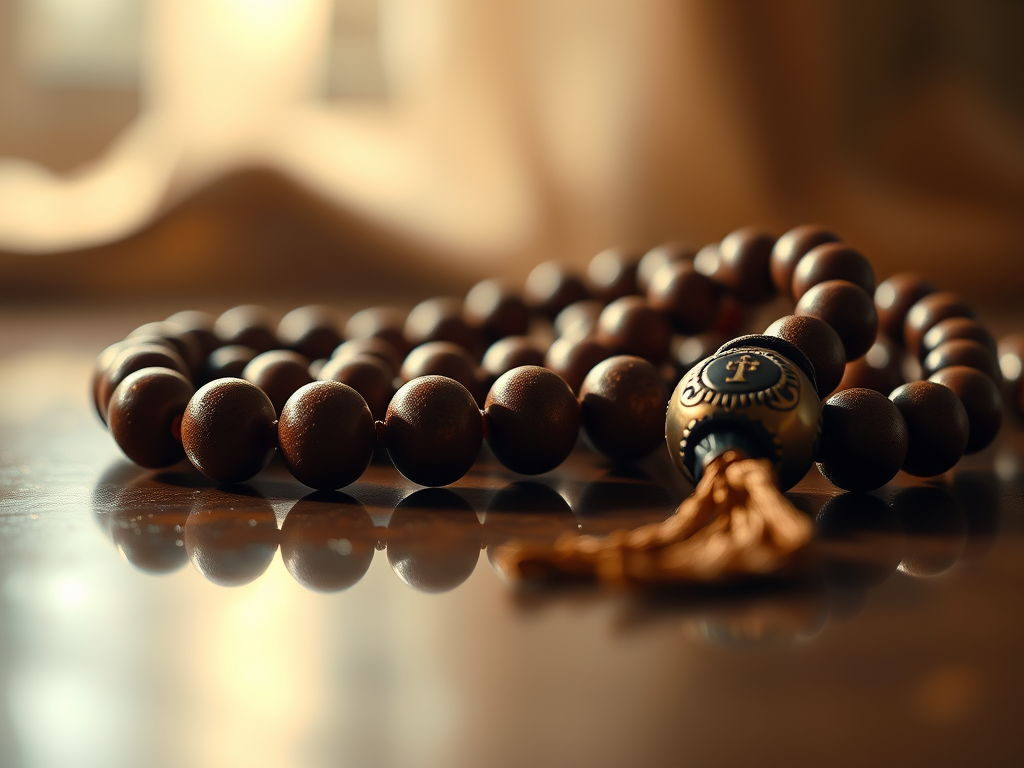
Various religious traditions encompass unique forms of meditation. Meditating has numerous benefits. It can help you relax, increase focus while giving clarity. It breaks you away from the hustle and bustle of everyday life and gives you a chance to recenter yourself on what is important. Thereby refocusing and reflecting. Depending on how you meditate it can help you become more resilient and compassionate. And I think for me it gives me clarity. Because I am separating myself from everything, I become more aware what’s most important. And it isn’t me.

When I was living in Arizona I was having a hard time finding a store which was open that had a rosary. I met a very nice lady who gave me her prayer rope so that I would have something to meditate on. It was called Tasbih (the Islamic prayer rope). I was much appreciative that she understood the importance to me of praying.
The picture to the left is very similar to my Tasbih. It was a gift from this dear person, a symbol of understanding each other. She didn’t try to teach me her way of using it. She didn’t even want it returned, even after I expressed my gratitude. She felt that I would treasure it just as much as she did. The one she gave me had darker beads. I am sure each bead carried a memory for her.
The Orthodox prayer rope, also known as Comboschini, holds a significant place in the spiritual practices of Orthodox Christians. I knew they prayed the Jesus Prayer on it. I assumed that it meant it was the Lord’s Prayer (Our Father). But over the years I have learned the Jesus Prayer is “Lord Jesus Christ have mercy on me a sinner” or “Most Holy Theotokos save us.” The Jesus Prayer, has deep roots in the Christian tradition, tracing back through centuries of monastic practice. When I asked an Orthodox priest about the prayer, he told me that if I do the prayers correctly, I may never finish praying.

The prayer rope can be made of 10, 25, 50 or even more beads. The prayer rope above is mine. It has a 100 wooden beads which I recite “Precious Blood of Jesus Christ have mercy on us and the whole world.” five times. I heard a priest ask us to recite this small prayer.
According to St. Seraphim of Sarov (Canonized Orthodox Russian Monk), ” Man achieves fullness of prayer not when he expresses himself, but he lets God be most fully present in prayer .” He is a beloved Russian saint who within the Roman Catholic faith is promoted by the Eastern Catholics and venerated by others.
When most people consider the rosary, they think of the traditional rosary which consist of 59 beads, and a crucifix. But there are two other rosaries: the Franciscan Crown, and Bridgettine Rosary. The external difference between each is::
- Traditional Rosary is 59 beads with the crucifix starting the prayers. It has 5 decades.
- The Franciscan Crown is 7 decades and a crucifix, and is used as a devotion to the Virgin Mary.
- Bridgettine Rosary consists of 15 decades and a crucifix.

I have always prayed the Traditional Rosary. It consists of five decades. Each decade begins with the Our Father, followed by the Hail Mary, and ends each decade with the Doxology and the Fatima Prayer (“Oh my Jesus, forgive us our sins, and those of the whole world.“) I will get into more detail about this rosary in a later post. There is more to this rosary than just saying these prayers over and over. I make these rosaries. The other two rosaries I will need to learn. I am sure there is even more I can learn from them.
Currently, I am excitedly planning to create two prayer meditation ropes. One of these is the Saint Michael the Archangel Chaplet, a devotion prayed in honor of Saint Michael and the nine choirs of angels. I deliberately purchased the chaplet to honor Saint Michael and deepen my understanding of the choirs of angels through praying the chaplet. Although I haven’t crafted the chaplet yet, it’s at the top of my to-do list. For each choir, specific graces are sought, and I can’t wait to say each prayer with each grace in mind.

The next “rope” chaplet is Our Lady of Sorrows. This chaplet invites you to meditate on the seven sorrows of Mary, providing an opportunity for deep reflection and spiritual growth. Saint Alphonsus Ligouri’s book delves into each sorrow, offering profound insights and guidance for those seeking a closer connection to the Blessed Mother. Each sorrow represents a pivotal moment in Mary’s life, and the book provides a comprehensive exploration of these significant events.

Do you have any special prayers that fill you with hope and positivity? I’d love to hear about the prayers that inspire you. Prayer can be a powerful source of comfort and strength, lifting our spirits and guiding us through challenging times. Whether it’s a traditional prayer passed down through generations, or a personal, heartfelt expression of faith, each prayer carries its own unique significance. Perhaps it’s a prayer of gratitude, acknowledging the blessings in our lives, or a prayer for guidance and clarity during moments of uncertainty. Sharing these prayers can bring us closer as a community, fostering a sense of connection and mutual support. Feel free to share the special prayers that resonate with you.

Responder a myallaboutyouCancelar respuesta