


A Pilgrimage Through the Apostles
Matthew
When I was a kid, my mother worked for the state revenue department. She helped people with their taxes.
We teased her about it. My brothers and sisters and I would say she was a tax collector, and we said it the way kids say it, like it was something to be a little ashamed of.
She always answered the same way. “It’s really not the way y’all think. I’m a good guy. I try to help people out.”
Like we believed her. Wink! Wink!
I think about that when I read about Matthew.
Have you ever been judged by your job title before anyone knew you?
Tax collectors weren’t liked in Matthew’s day either. More so, in fact. In the old days, a collector could add a surcharge on top of what was owed, and that’s part of why people despised them. Scripture doesn’t tell us whether Matthew did that. It tells us what he did for a living.
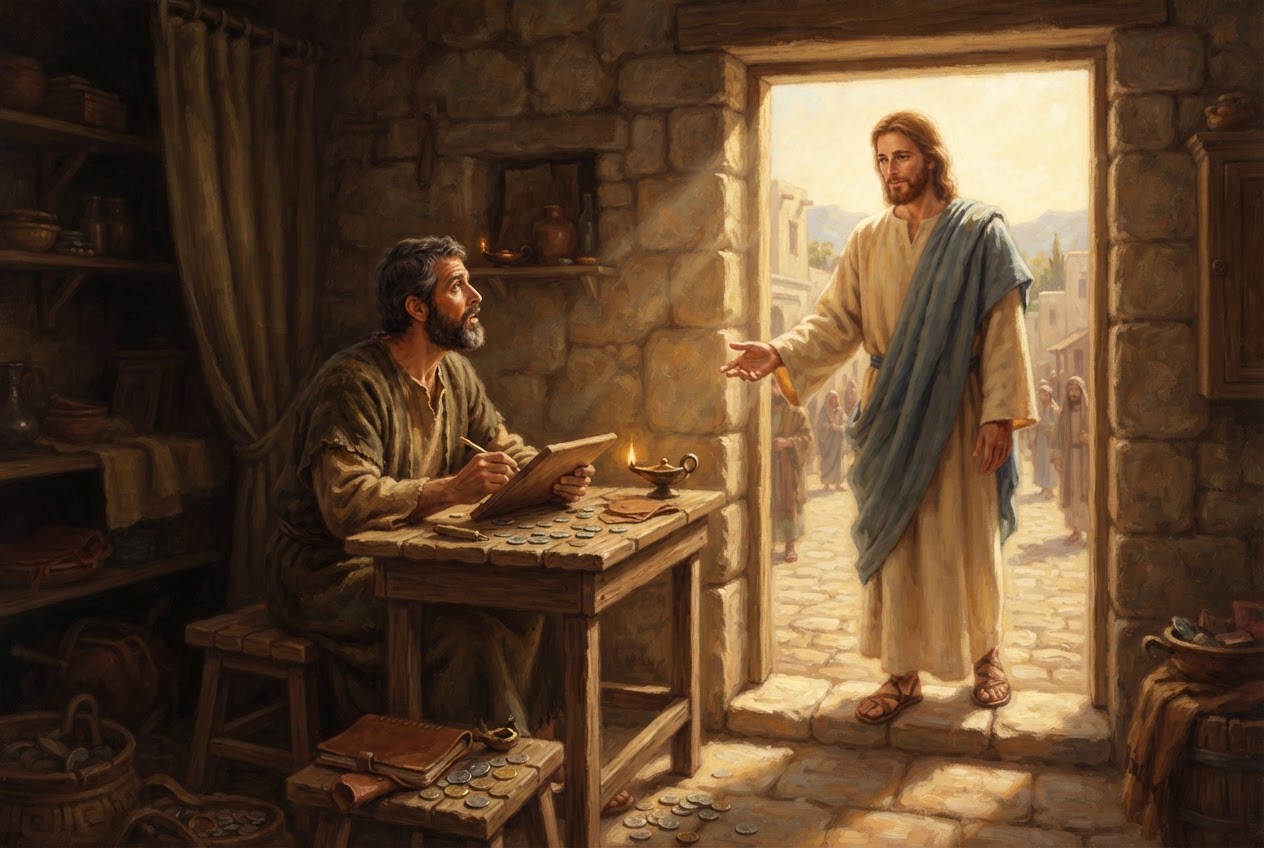
Imagine yourself as Matthew. You sit in the tax office every day. You know how people look at you when they walk up. Some won’t look at you at all. Then one day a man stops in front of you and says:
“Follow me.”
Matthew 9:9
What were you thinking in that moment? What were you feeling?
Matthew’s Gospel gives us very little to go on. He rose and followed him. No question, no bargaining, no time to settle his accounts.

Who Was Sitting in That Booth?
I believe Jesus accepted Matthew before he ever asked him. Look at the order. Jesus sees a man the whole town has already decided about, and the first words out of his mouth are an invitation.
I think that was the mercy. Not a lecture. Not a list of what Matthew needed to fix first. Just: follow me.
So here is how I read it, and I’d like you to test it against the text yourself.
Acceptance. Then mercy. Then conversion.
Jesus accepts him where he sits. The invitation is the mercy. And Matthew’s response, getting up and leaving the booth, is the conversion.
Could mercy come before acceptance? I wondered about that. But here I don’t see how. The call itself is the mercy, and it comes to a man Jesus has already accepted.
What would it mean to be accepted before you had changed a single thing?
Comfortable on the Outside
The other four we’ve already walked with were fishermen. Peter, Andrew, James and John worked out in the weather. Cold, wet, tired, and exposed to the elements.
Matthew sat in a stall.
In some ways, he was the most comfortable of them. He had a roof and a steady income. I believe the fishermen endured more physically.
But I don’t think Matthew was comfortable where it counted. The fishermen had each other. Matthew had a booth, and the people who walked up to it did not want to be there.
He was warm and dry, and he was lonely.
Who do you know that has everything and still sits alone?
And how many of us have been the one who kept our distance?
One thing I noticed in Matthew’s Gospel is that he doesn’t hide what he was. In the list of the twelve, he is named this way:
“Matthew the tax collector.”
Matthew 10:3
Matthew kept it on himself. St. John Chrysostom reads that as humility.
I believe that took something. By naming himself, Matthew showed humility. But he also opened a door. In essence he was saying, “I was a sinner. Jesus forgave and accepted me. He can do it for you too.”
A Shepherd Before He Knew It
Luke tells us what Matthew did next. He left everything, and then:
“And Levi made him a great feast in his house; and there was a large company of tax collectors and others sitting at table with them.”
Luke 5:29
Matthew had just been called. He hadn’t been to a single sermon. He hadn’t been trained. And the first thing he did was call his friends.
I believe that was Matthew shepherding, before he knew the word for it.
That’s what sent me to Ezekiel 34. God speaks there against the shepherds who didn’t look for the lost, and then he says:
“Behold, I, I myself will search for my sheep, and will seek them out.”
Ezekiel 34:11
God does the seeking. Jesus walks up to a booth and seeks out a man nobody else was looking for. And the moment Matthew is found, he turns around and starts gathering the ones nobody else was looking for either.
He gave the dinner for Jesus. But I think he also gave it for them.
He wanted Jesus to meet the people who lived on the edge. And I think he wanted to give Jesus his best, the people who knew him.
Who was the first person you brought or would bring to Jesus?
Who is sitting at the edge of the table that hasn’t been invited yet? I think if I sat and thought about it a second, I would discover people who I didn’t realize were on the edge.
Mercy, Not Sacrifice
Not everyone liked the guest list.
“Why does your teacher eat with tax collectors and sinners?”
Matthew 9:11
I wondered why Jesus answered the way he did. He doesn’t defend Matthew. I think Jesus didn’t feel Matthew needed defending. Instead, he turns the question into a lesson for the people asking it. And he uses a physician, which is something they could understand.
“Those who are well have no need of a physician, but those who are sick. Go and learn what this means, ‘I desire mercy, and not sacrifice.’ For I came not to call the righteous, but sinners.”
Matthew 9:12-13
That last line stopped me. Because sacrifice is something we can do. It’s an action. You can show up, go through the motions, and check it off.
Mercy is harder. It asks for your heart.
So I asked myself the question. Do I go through the action and have nothing personal invested in the emotion?
There’s a difference between going through the motions and committing myself entirely. I can see where that applies today.
Where in our lives are we offering sacrifice and holding back mercy?
Where the Compass Points
I don’t know if I’m doing what he asks of me. I’m trying to keep my commitment. I’m asking to be shown the way.
Matthew didn’t have it figured out when he stood up. He got up first. The understanding came later.
Who do we know that Jesus is seeking right now? And what would it cost us to get up from our booth and follow?
Which apostle do you see yourself in? Tell me in the comments. I’d like to know.
References
For those who want to go deeper, these sources shaped this reflection.
Scripture
Matthew 9:9–13 — The calling of Matthew, the dinner, and Jesus’ answer about the physician and mercy.
Matthew 10:1–4 — Matthew named among the Twelve as “the tax collector.”
Luke 5:27–32 — Levi leaves everything, follows Jesus, and gives a great feast.
Ezekiel 34:11–16 — God promises to seek out his own sheep.
Further passages naming Matthew among the apostles: Mark 3:13–19 · Luke 6:12–16 · Acts 1:12–14.
The fuller passage, Ezekiel 34:11–16 (RSV): “For thus says the Lord GOD: Behold, I, I myself will search for my sheep, and will seek them out. As a shepherd seeks out his flock when some of his sheep have been scattered abroad, so will I seek out my sheep; and I will rescue them from all places where they have been scattered on a day of clouds and thick darkness. And I will bring them out from the peoples, and gather them from the countries, and will bring them into their own land; and I will feed them on the mountains of Israel, by the fountains, and in all the inhabited places of the country. I will feed them with good pasture, and upon the mountain heights of Israel shall be their pasture; there they shall lie down in good grazing land, and on fat pasture they shall feed on the mountains of Israel. I myself will be the shepherd of my sheep, and I will make them lie down, says the Lord GOD. I will seek the lost, and I will bring back the strayed, and I will bind up the crippled, and I will strengthen the weak, and the fat and the strong I will watch over; I will feed them in justice.”
Early Church
St. John Chrysostom, Homily 30 on Matthew — his reflection on Matthew’s calling and on Matthew naming his own occupation as humility.
On reading Matthew
The portrait of Matthew, the idea that he began shepherding the moment he was called, and the order of acceptance, mercy and conversion are my reflections on these passages. Scripture records his actions without explaining his thoughts or motives. Christian tradition identifies Matthew with Levi, son of Alphaeus, though the text does not explain the two names. I invite you to read the passages and consider what you see.
Leave a Reply