


“Follow me, and I will make you fishers of men.”
— Matthew 4:19
We’ve all read those words many times over the years. Most of us know that Peter, Andrew, James, and John were fishermen. It’s simply another detail in the Gospel story. We read it, picture a boat floating on the water, and continue to the next verse.
I know I did.
That began to change as I reflected on Andrew’s life. The more I studied him, the more I found myself slowing down. Little details that I had passed over countless times suddenly seemed worth another look: a single word, a passing comment, a question I had never thought to ask.
One question, in particular, refused to leave me.
Why fishermen?
Living in South Louisiana, fishermen have always been part of the landscape. Long before sunrise, boats quietly leave the bayous and winding waterways for the Gulf of Mexico. If you’ve ever sat at a lift bridge waiting for a fishing boat to pass beneath, you’ve caught a glimpse into their world. While the rest of us are just beginning our day, theirs has already been underway for hours.
I’ve watched them enough over the years to know that fishing is much more than catching fish. Before a boat ever leaves the dock, someone checks the engine. Someone looks over the nets. Someone makes sure the ropes are where they belong. The water has a way of exposing the smallest oversight, so experienced fishermen learn not to rush.
Their work changes them.
The sun leaves its mark on their faces. Rope leaves its mark on their hands. Years on the water teach them to notice changing weather, shifting currents, floating debris, and subtle signs that most people never see because, on the water, those small details often become very large problems.
Watching them made me realize something I had never connected to Scripture.
An occupation doesn’t simply provide a living.
It quietly shapes the people who live it.
That simple observation carried me halfway around the world to another shoreline.
What kind of men were shaped by the Sea of Galilee?
The first thing that surprised me was the lake itself.
Although we call it the Sea of Galilee, it is actually a freshwater lake resting nearly seven hundred feet below sea level. Where I live sits about fifty feet above sea level. Even New Orleans, often described as being built in a bowl, lies only slightly below sea level in many places. The Sea of Galilee rests hundreds of feet lower still, surrounded by hills that seem almost to gather around the water.
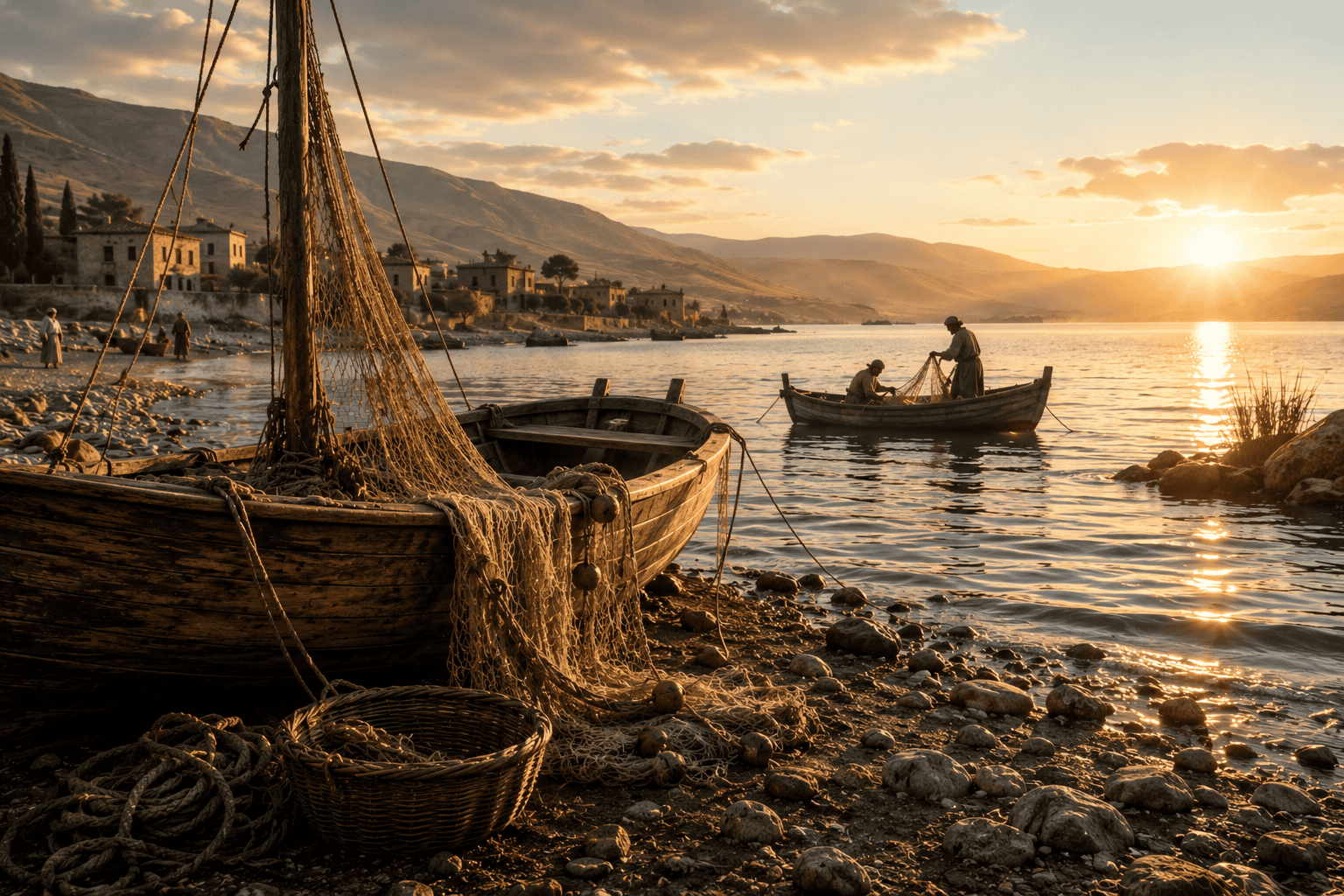
Everything about the landscape feels different. The flat marshes of Louisiana disappear. In their place rise rocky hillsides scattered with olive and fig trees. Reeds line portions of the shoreline, and in the spring, wildflowers color the surrounding hills. Fishing villages such as Capernaum, Bethsaida, and Magdala were close enough that fishermen could often see neighboring communities across the lake.
The water connected them all. Boats carried fish to market, merchants from village to village, families visiting relatives, and the news of the day from one shoreline to another. The Sea of Galilee wasn’t simply a landmark. It was woven into the fabric of everyday life.
Not far to the south, the Jordan River flowed toward the lake after descending from the north. Somewhere along those waters, Jesus was baptized by John. Soon afterward He entered the wilderness before returning to begin His public ministry throughout this region.
The more I pictured it, the more I realized I had never truly imagined it before.
Before dawn, the lake rested quietly beneath the stars. The air carried the scent of freshwater mixed with fish, damp nets, wet rope, weathered wood, smoke from breakfast fires, and the rich smell of the earth along the shoreline. Gulls called overhead while herons searched the shallows. Boats rocked gently against the shore as fishermen prepared for another day’s work.
One detail especially surprised me.
The water was cold.
Somehow I had always imagined Peter standing in warm water. Instead, the Sea of Galilee is continually fed by the Jordan River flowing south from the slopes of Mount Hermon. Especially before sunrise, and during the cooler seasons, the water could be surprisingly chilly. Every morning these fishermen stepped into that cold water to push their boats away from shore before climbing aboard.
The Sea of Galilee was beautiful, but it wasn’t gentle. Because the lake rests deep within a basin surrounded by hills, cool air could suddenly rush through the valleys and collide with the warmer air above the water. A peaceful morning could become rough in a remarkably short time.
Fishermen learned to pay attention. They watched the wind. They noticed birds behaving differently. They studied the clouds gathering over the hills. They felt subtle changes in the air. They read the water.
The lake was teaching them every single day.
The fishermen of the Sea of Galilee knew their business.
They knew the lake.
They respected its power.
They understood their trade.
Perhaps…
there was still one lesson waiting to be learned.
References & Notes
For those who want to go deeper, these sources shaped this reflection.
Scripture
Matthew 3:13–4:22 · Mark 1:9–20 · Mark 4:35–41 · Luke 5:1–11.
A Note on the Reflection
The comparison with Louisiana fishermen and the imagined shoreline scenes are personal reflections.

Leave a Reply