


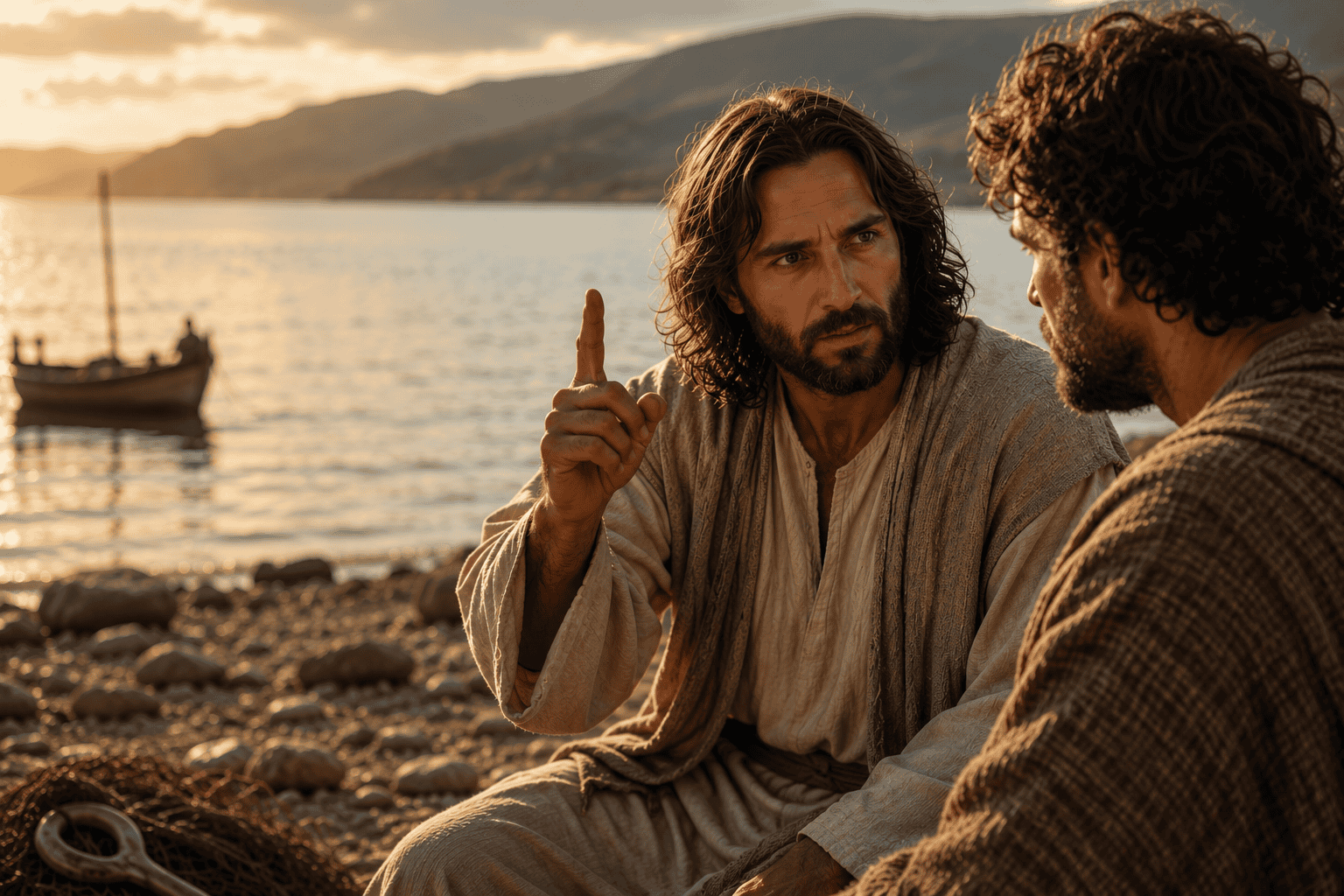
Matthew 16
“You are not on the side of God, but of men.”
— Matthew 16:23
In our last post, we met Peter at the moment Jesus gave him a name: Rock. But there’s something we need to understand. Jesus didn’t discover who Peter was. He knew. He had always known, even in Peter’s mother’s womb, the way God knows us all before we are formed. Just as Abraham was renamed before he understood what that name would cost him, Peter was called Cephas before he could possibly know what it meant.
Jesus knew him completely. He also knew what grace would make of him. He knew Peter would grow into the man who would strengthen his brothers and help lead the faithful home to heaven.
But here’s what matters most: Jesus knew that actions don’t always match what is truly in the heart. We all make mistakes, especially when we try to manage our own way instead of trusting His. But a mistake doesn’t equal a disloyal heart. Peter would rebuke Jesus. Peter would deny Him. Yet Jesus never withdrew the name He had given. Because what mattered wasn’t Peter’s flawless performance. What mattered was that Peter’s heart remained loyal, even when his actions betrayed him.
Have you ever felt that deep uneasiness that comes when you’re trying to force something instead of trusting God? Many of us have. Sometimes it is our conscience reminding us that we’ve begun relying on ourselves instead of resting in His grace. That uneasiness is a gift. It tells you something true: you’ve shifted from trust to flesh-and-blood thinking.
That’s what happened to Peter.
Peter did not understand fully what it meant to be the Rock. He didn’t understand fully what it meant that Jesus was the Messiah, and he didn’t understand fully what he was going to give up to receive the keys. Little did he realize that following Christ would eventually require everything, even his own life.
Perhaps Jesus blessed Peter because He knew what was coming. The powers of Hades would be against the bearer of the keys. Peter would face darkness that required grace stronger than his own. So Jesus blessed him first. Not after the trial. Before it.
Peter would need grace far greater than his own strength if he were to become the shepherd Christ intended. The blessing both strengthened and equipped him for the work ahead. Jesus knew Peter’s journey would not be easy. He knew Peter would need every grace to become the man He had called him to be.
Jesus rebuked Peter because Peter was trying to protect Jesus, out of love, out of loyalty. But in trying to protect Him from suffering, Peter was essentially trying to rewrite God’s redemptive plan. He was a fixer. He saw what he thought was wrong and tried to fix it. He couldn’t accept that the Father’s will required a cross. So he tried to manage it, undo it, protect Jesus from what the Father had decided.
And Jesus said:
“Get behind me, Satan.”
Not because Peter didn’t love Him.
Peter loved Him deeply.
But love without trust can still resist God’s will.
Peter had not yet learned to think like God.
His heart belonged to Christ. His mind was still being renewed.
The rebuke was the beginning. After being emptied of confidence in himself, by Jesus’ words, by his own denial that was coming, and by every failure that would follow, Peter was molded into the servant leader he was meant to be.
Peter’s love was never in question. His heart was perfectly loyal. What Jesus was teaching was not about how much Peter loved, but how love expresses itself when you’re thinking like God instead of like men.
Before: “I will never deny You.” Peter trusted Peter.
After the Resurrection: “Lord, You know everything; You know that I love You.” Peter trusted Christ.
Not through instruction. Through fire. Through loss. Through learning that grace holds even when you’ve fallen. That’s how Peter learned to lead with humility. That’s how he became the Rock, not through strength, but through having been shattered and rebuilt by God’s hands.
God enters into our lives quietly, guiding us along the way. He gives us grace to walk through this life, not as a destination we reach, but as a pilgrimage we live. The journey toward God is the process of making Him our home.
The Prayer
As I sit here learning about Peter, I see a man who was shaped by Your presence. You knew him and named him before he even knew You. You knew the man he was, the man he would become, and the grace that would carry him between the two. Just as You do us.
You knew us in our mother’s womb and called us by name before we even had a name.
For Those Who Want to Sit Deeper with Peter’s Story
Why does Jesus ask these questions in this order?
He asks the disciples first because He was watching how they would respond and wanted Peter to think it through so that, through God’s grace, he would know the answer. Conviction cannot remain secondhand. Faith cannot remain secondhand. Peter cannot build the Church on what other people believe.
Then He makes it personal.
Why does Jesus respond so strongly?
Because the Father revealed the truth to him. The Father reveals what flesh and blood cannot.
Why bless Peter first?
Because Jesus doesn’t merely assign Peter responsibility. He gives him grace before responsibility. God equips before He sends.
Why Peter?
Because he was chosen, as we all are chosen. But his mission was unique. Peter wasn’t chosen because he was better. He was chosen for a particular work.
What does Peter understand?
He doesn’t fully understand. He hears but doesn’t yet comprehend completely.
Compare Luke 5. Peter trusts Jesus enough to cast the net. Now, in Matthew 16, Peter recognizes Jesus as the Christ. His faith is deepening. It still has a long way to go, but it is growing.
Peter didn’t realize this fulfilled what Jesus had already spoken over him. He grew into understanding what God was molding him to be.
Peter didn’t become something different.
He became what Christ already saw.
What did Peter feel when Jesus repeated the name “Rock”?
When Jesus first called him Cephas, Peter was probably confused and perhaps a little put off. Later in life he most likely understood more, though never completely. I think he continued growing into his role. But he knew he was willing to die for Our Lord. He knew that he loved Him and trusted His ways. He knew His grace.
God offers us this same grace.
This is us.
We don’t know what God is growing us into.
Did Andrew smile?
I like to imagine Andrew smiling. Because when I put myself in his shoes, the brother who brought Peter to Jesus and then watched him be commissioned, I would have the biggest smile on my face.
Andrew saw something in Peter before Peter fully saw it himself.
Why does Matthew place the confession before the rebuke?
Matthew could have separated these events. He intentionally didn’t.
The confession…
Then the blessing…
Then the rebuke…
Almost as if he is saying Peter is capable of hearing directly from the Father… and thinking entirely like man… sometimes within minutes.
That’s Peter.
And honestly…
That’s us.
The Order of Transformation
Revelation → Testing → Commission (refined)
Not revelation and then immediately to work.
The testing comes before the mission.
The fire refines you first.
Peter confesses.
He is tested immediately through the rebuke.
Then he goes on to lead.
We receive revelation about our calling.
We are tested through anxiety, our attempts to manage, our fear.
Then comes the real work, refined by grace.
Matthew is teaching us that we don’t lead until we have been tested.
We don’t become who God is calling us to be without first learning to think more like Him.
References & Notes
For those who want to go deeper, these sources shaped this reflection.
Scripture
Matthew 16:13–23 · John 1:42 · Luke 22:31–32 · Psalm 18:2 · Isaiah 51:1–2 · Luke 5:1–11 · Romans 12:2.
A Note on the Reflection
Peter’s imagined feelings and my reading of his formation are personal reflections on these passages.
Leave a Reply