


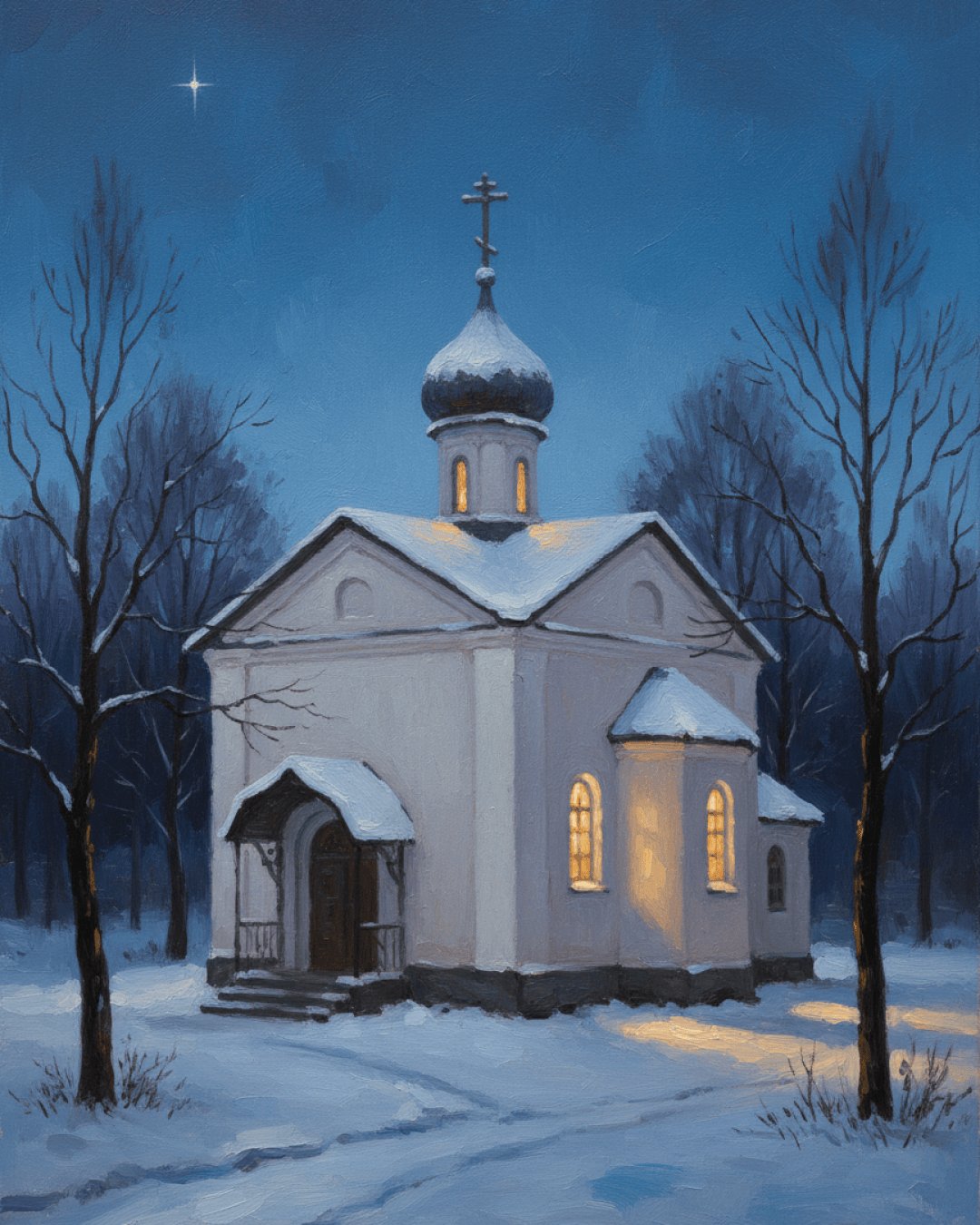
As you know, the Church breathes with two lungs, the East and the West.
So far we’ve looked at two fasts from our own lung, St. Martin’s Lent and the Franciscan fast. Now there’s another, from the other lung.
They help us breathe in and breathe out. Together we make motion.
Remember Peter and Andrew? Two brothers, two lungs. The First One Called
What the Fast Looks Like
The Orthodox keep a fast of their own before Christmas. It starts on November 15 and runs forty days. It’s called the Nativity Fast, or Philip’s Fast, because it begins the day after the feast of the Apostle Philip.
Per Orthodox church sources, the fast traditionally means no meat or dairy. Here is the general pattern. Practice varies by parish and jurisdiction.
| Days | What is allowed |
|---|---|
| Monday, Wednesday, Friday | No fish, wine or oil |
| Tuesday, Thursday | Wine and oil, but no fish |
| Saturday, Sunday | Fish is allowed |
| December 20 to 24 | Tighter again, no fish |
Our Orthodox brothers and sisters keep forty days, which in my opinion mirrors the forty days Jesus fasted in the desert, and the other times forty turns up in the Old and New Testaments.
I own an Orthodox vegetarian Lenten cookbook. It never occurred to me that Orthodox Christians could be vegetarians. I haven’t cooked anything out of it yet. I stick pretty much to eating what I normally eat. But I bought it because I wanted to learn from their experience, and I want to share what I find.
A Little of the History
When most people think of the Orthodox Church, they think ornate. Lots of incense. Icons. The Orthodox love to bring all five senses into worship.
But I’ve been to a few Orthodox churches in my life, and they were generally small. The last one I visited was a small, plain parish, not the grand cathedral people picture. There was no incense. People stood when they came in, instead of kneeling and sitting. They crossed themselves three times.
What felt familiar? Communion. And the readings.
Some things I recognized right away. But the fast itself has a longer story, and it didn’t always last forty days.
In the twelfth century, a Church lawyer named Theodore Balsamon described the Nativity Fast as a seven-day fast, according to several Greek Orthodox sources. Under the influence of Great Lent it was later stretched to forty days, without the strictness of Lent.
By 1166, a council in Constantinople tied the fast to forty days. It is described as joyful expectation, not gloom. The Christmas hymn “Christ is born, glorify Him” begins to be sung on November 21.
You may not realize that there are people who do not use the same calendar we do. Originally the calendar was the Julian calendar, and it had a few idiosyncrasies. It ran slightly long, so over the centuries its dates drifted away from the seasons. In 1582 Pope Gregory XIII corrected it, and the Gregorian calendar is the one most of the world uses now.
Some Orthodox churches kept the older Julian calendar. Today it runs 13 days behind ours. So their fast begins on November 28 on our calendar, and their Christmas falls on January 7. Many Orthodox churches keep our dates: the fast begins November 15 and Christmas is December 25.
Same feast. Same Christ. Different calendar.
What I’m Trying This Advent
So that’s the Orthodox fast, as I understand it. Here’s what I’m trying this Advent.
One meal a day on Monday, Wednesday and Friday. Quiet: cutting back on TV and noise, with a little religious music. A calm, organized house. Fewer gifts: one family gift for households far away to use for time together, and for family nearby, gathering with no gifts.
A different form of the same kind. Fasting from food, noise and gifts: different forms, same purpose.
For me, the hardest thing to give up will be the gifts. I like to have things under the tree, and I like giving. Remember St. Martin? He gave half his cloak to a beggar. It cost him something. Giving up the gifts will cost me something too. What I hope to give instead is my time.
A friend from Germany did one gift. With my own children, we did three: a small one from Santa, a bigger one from Mom and Dad, and the one they really wanted from baby Jesus. It didn’t even occur to me at the time, but three gifts echoes the three gifts of the Magi. And the best one came from Him.
If you decide to try the fast, take it one step at a time.
My wish to you: be rich with the gifts of Jesus.
What Comes Next
Next, we’ll recap all of the fasts together. Then we go back to the Old Testament.
References & Notes
John Sanidopoulos, “The Nativity Fast”, and the Antiochian/ACROD article on Advent — the Orthodox history of Philip’s Fast, its forty-day length and its joyful character.
The 1166 council at Constantinople appears in several Orthodox sources, including Orthodox Times and OrthoChristian. The seven-day fast in Balsamon’s time appears in Greek Orthodox sources. I have not yet checked Balsamon’s own Greek text.
Matthew 4:1–2 — Jesus fasts forty days in the wilderness.
The food rules in the chart are general Orthodox practice and vary by parish and jurisdiction. They are not a rule I am keeping. The forty-day comparison, my church visit, the cookbook and my Advent plan are my own reflections.
Leave a Reply