


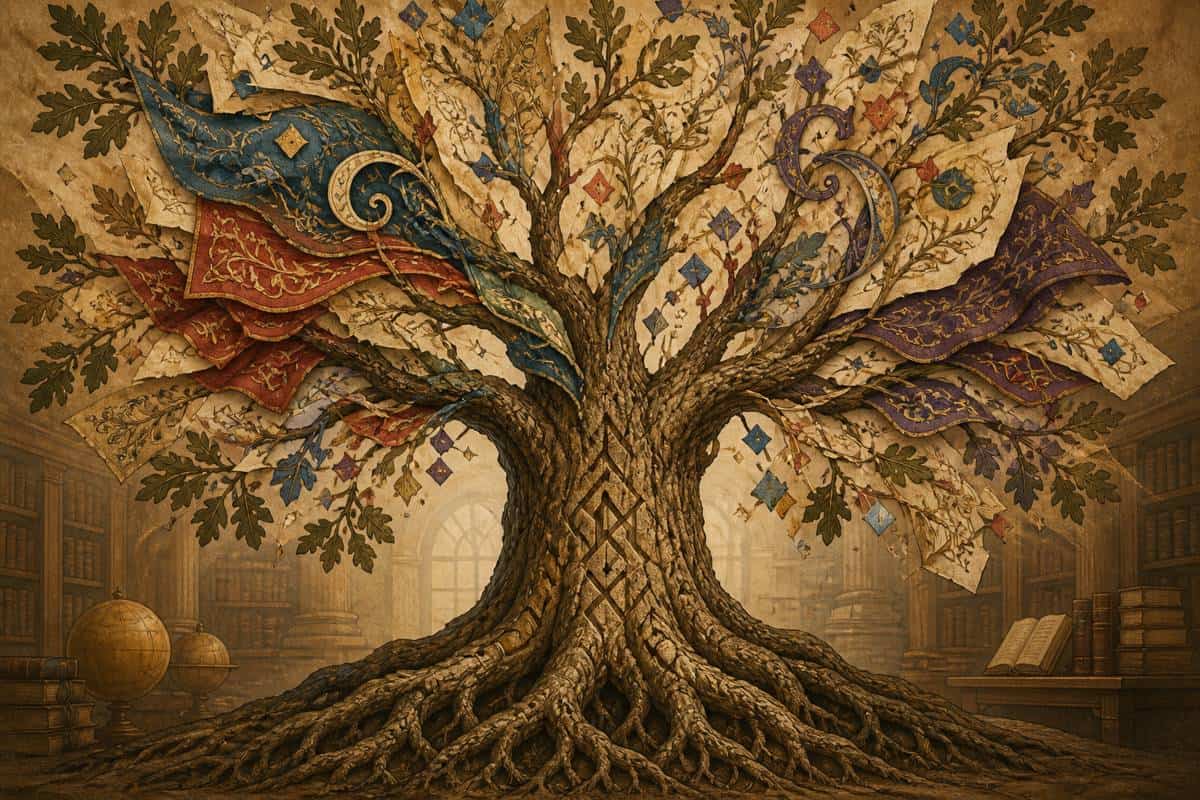
English can be confusing at a family reunion. Its closest relatives are Germanic, yet it arrives wearing French vocabulary, carrying Latin books, and telling stories filled with words gathered from around the world. How can English still be called Germanic?
A language family is about ancestry
Linguists classify languages by descent, not by counting borrowed words. English developed from West Germanic varieties brought to Britain by Angles, Saxons, Jutes, and other groups. Its most basic framework—including many pronouns, irregular verbs, and everyday words—still shows that ancestry.
Words such as mother, father, house, bread, water, come, go, see, and sleep sit close to the language’s foundation. The grammar has changed dramatically over the centuries, but the oldest structural bones remain Germanic.
Then came the Norse neighbors
Contact with Old Norse added common words such as sky, window, egg, take, and they. Because Old English and Old Norse were related, speakers could recognize pieces of one another’s speech. Long contact helped simplify some endings and reshaped everyday English.
French entered the household
After the Norman Conquest of 1066, forms of French became powerful in government, law, landholding, and elite culture in England. English continued among the wider population, but it absorbed thousands of French words. That is why English has vocabulary associated with courts, government, cuisine, fashion, art, and social rank that often traces through French.
English sometimes kept both the older everyday word and the newer formal one: ask and inquire, kingly and royal, freedom and liberty. These pairs give writers choices in tone.
Latin never stopped contributing
Latin vocabulary entered English through the Church, education, science, medicine, law, and later scholarly invention. Greek roots also became building blocks for technical terms. A simple conversation may lean Germanic, while an academic paragraph can look heavily Latin and Greek.
Borrowing does not erase belonging
Languages borrow because people meet. Trade, migration, conquest, worship, scholarship, invention, and popular culture all leave words behind. English has borrowed from Arabic, Hindi and Urdu, Indigenous languages, African languages, Japanese, Spanish, Italian, and many more. Each loan tells a human story.
The wardrobe metaphor
Think of English as an old Germanic house that has been remodeled for centuries. The foundation and load-bearing frame show its ancestry. French furnished many rooms. Latin stocked the library. Norse altered the kitchen. Generations of visitors brought new tools, foods, ideas, and names.
English is Germanic not because it stayed pure—no living language does—but because that is where its continuous family line begins. Its enormous borrowed vocabulary is not a contradiction. It is the record of everyone English speakers have encountered.

Leave a Reply