


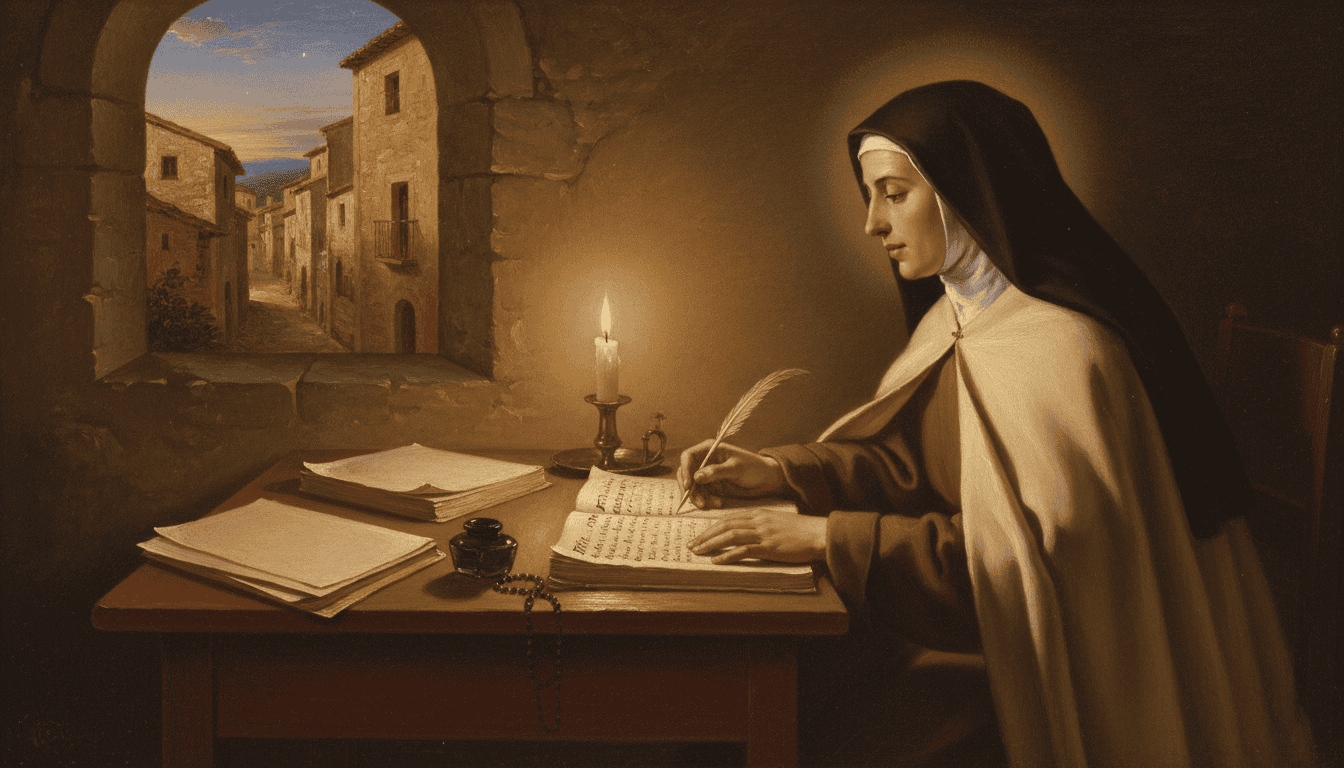
On the night of October 4, 1582, Spain went to bed. The next morning was October 15.
Ten days simply vanished. The old calendar had slipped out of step with the seasons, and Pope Gregory XIII had set it right. Spain was one of the first countries to switch. Thursday, October 4, was followed by Friday, October 15.
And on that very night, in a convent in Alba de Tormes, a Carmelite sister was dying. Her name was Teresa of Ávila. She was sixty-seven years old.
That is why the Church remembers her on October 15 and not October 4. Her feast day is a day that almost did not exist.
Teresa was born in Ávila, Spain, in 1515. She became a Carmelite nun, and she spent much of her life helping her order return to prayer, simplicity, and quiet. She wrote books about talking with God that people still read today. In 1970, Pope Paul VI named her a Doctor of the Church, one of the first two women to be given that title.
Tradition remembers her last words this way: “In the end, I am a daughter of the Church.”
She was practical, warm, and not easily rattled. And she left behind a small poem. After she died, a slip of paper was found in her prayer book. In English, the lines are often translated something like this:
Let nothing disturb you.
All things are passing.
God only is changeless.
Patience gains all things.
God alone suffices.
(Translators word it a little differently. The poem is traditionally credited to her.)
Let me sit for a moment with the second line. All things are passing.
That is not a sad thought. Not really. It means the headache is passing. The long list is passing. The hard week, the hard season, the hard conversation you are dreading. They are all passing.
And what does not pass? Teresa says God. That is where she tells us to put our weight.
Maybe you would like to copy those lines on a small card today, in your own handwriting. Tuck it into a book, or a coat pocket, or the corner of a mirror. Let it be a bookmark for a hard day.
Teresa tucked hers in a prayer book, and it found its way to us.
Let nothing disturb you. God alone suffices. I like that thought.

Leave a Reply