


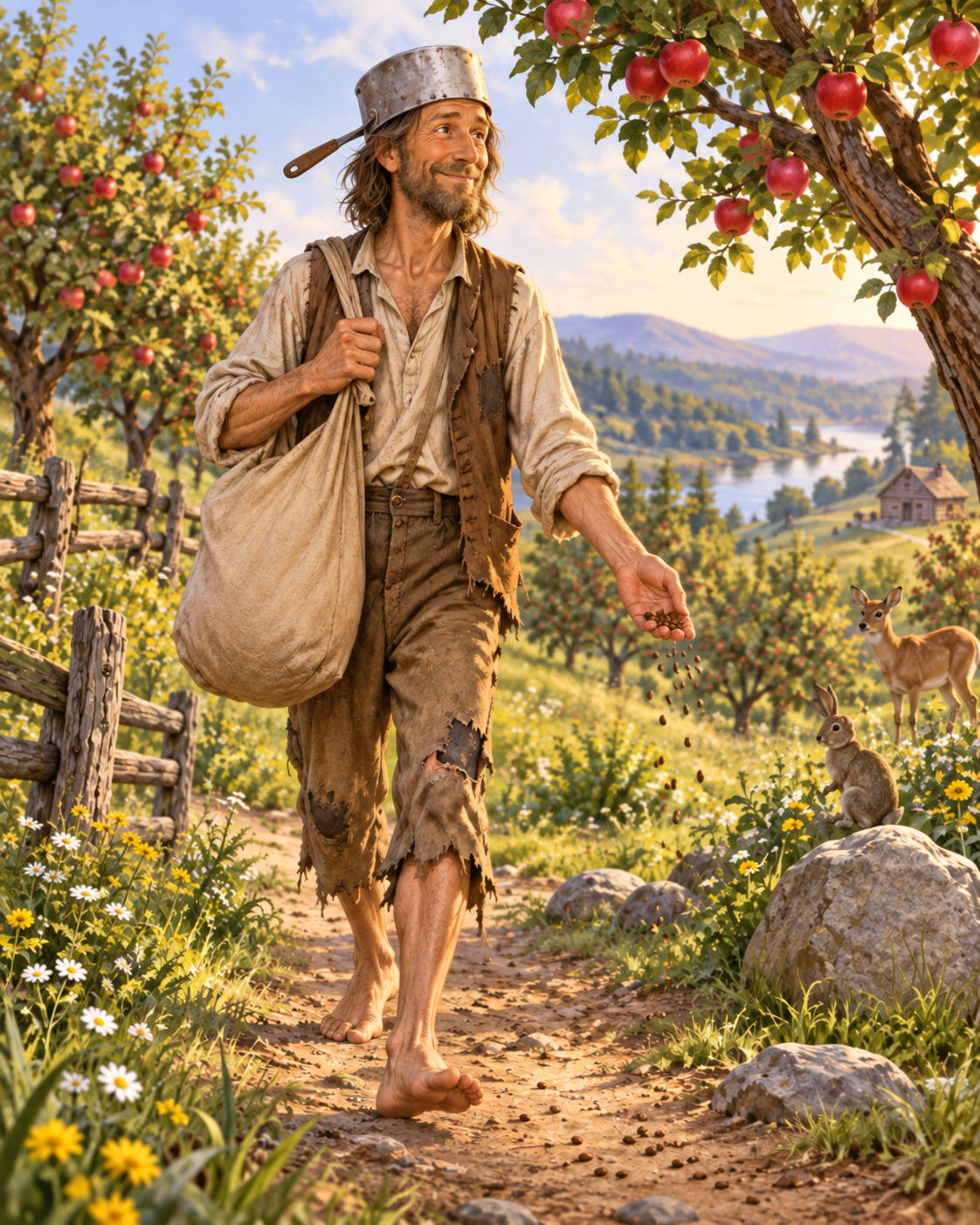
Today is Johnny Appleseed Day. It’s his actual birthday, September 26, 1774.
You probably already know the outline of him, a barefoot man wandering the frontier with a sack of apple seeds and a tin pot for a hat. I know I do. The teachers would give coloring sheets out in class while they taught us about him.
I have since learned that some of that is legend, stretched a little past the facts over two hundred years of retelling. But the man underneath the legend, whose real name was John Chapman, was genuinely remarkable, and he didn’t need any exaggeration to be worth remembering. I remember learning about him as a kid.
Chapman spent decades walking ahead of the American frontier, through Pennsylvania, Ohio, and Indiana, planting apple tree nurseries. Not orchards for eating apples off the branch which what I seem to remember. Most of what he grew from his seeds wasn’t sweet enough for eating. He planted from seed on purpose, refusing to graft trees the normal way orchardists did then and still do now, because he believed grafting hurt the tree. It wasn’t the practical choice. It was the choice that matched what he believed.
He’d plant a nursery, fence it to keep the deer out, and move on, coming back every year or two to tend it and sell or trade young trees to the settlers arriving behind him. By the time families reached a new stretch of frontier, there was already a small orchard of saplings waiting for them, planted by a man who’d walked through years before they ever arrived.
Think about that for a second. He was planting trees for people who hadn’t shown up yet.
Chapman lived simply, by every account. He didn’t marry. He didn’t build himself a house worth mentioning. He traded young trees for old clothes he genuinely needed, gave saplings outright to families who had nothing to trade, bought horses that were being mistreated just to set them free on good land, and kept to a plain, meatless diet his whole life. He was a devoted member of a small Christian church of his day, and he carried religious pamphlets along with his seeds, sharing what he called “news right fresh from Heaven” with anyone willing to sit and listen at the end of a long day’s walk.
And yet, when he died in 1845, records show he actually owned something like twelve hundred acres of land. He wasn’t a failure at building something lasting. He built plenty. He just kept giving almost all of it away as fast as he made it.
Did you know that most of the trees John Chapman planted, he never got to sit under? I know I didn’t.
An apple tree takes years to grow tall enough to give you real shade, and years more before it reliably bears fruit worth eating. Chapman moved on before most of his nurseries ever got there. He planted, and then he walked away, trusting that someone else, a family he might never meet, arriving on land he might never see again, would be the one to actually enjoy what he’d started.
That’s most of the good work worth doing, honestly. The garden you plant that a future homeowner will enjoy. The habit you build in a child that pays off twenty years from now, long after you’ve stopped watching for it. The quiet act of kindness to a stranger who never circles back to thank you, and never even knows your name.
You don’t often get to sit in the shade of the tree you planted. Most of the time, somebody else does. That’s not the tragedy it looks like from the outside. It might be the whole point.
Happy birthday to a man who understood that better than almost anyone, and who kept planting anyway.

Leave a Reply