


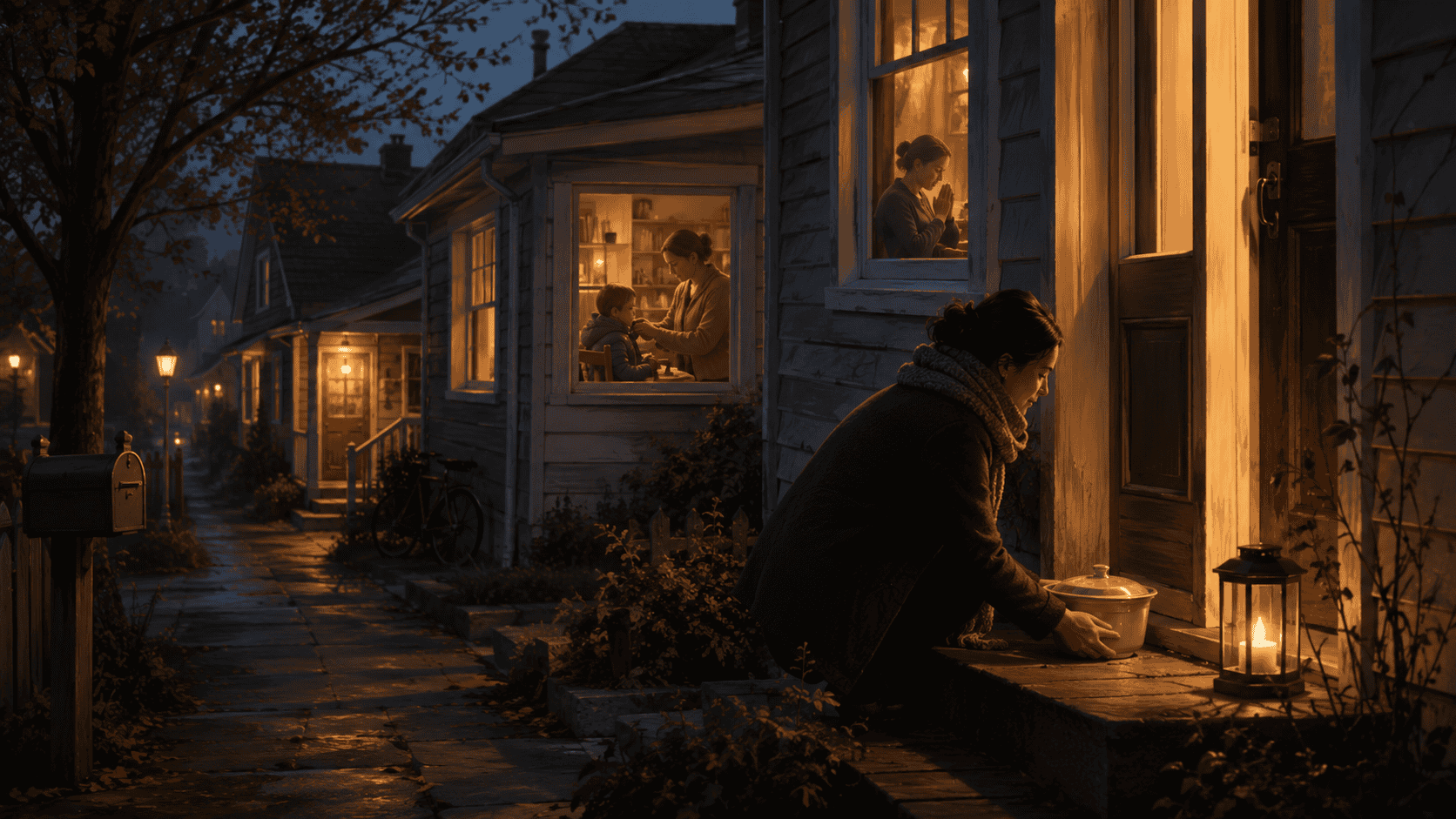
This post is part of The Lantern Practice, a series about learning to see beyond noise, anger, and the first story we tell ourselves.
Some days, nothing loud happens at all.
No headline breaks.
No argument erupts.
Nothing explodes, so there is no smoke to search through, no story to untangle.
Just an ordinary day.
And ordinary days are where this practice gets hard. There is nothing dramatic to carry the lantern toward. Nothing seems to be hiding. Nothing seems to need uncovering.
But that is not quite true.
Something is always happening beneath the noise. Even on the quiet days. Especially on the quiet days.
Back at the start of this practice, I said something I want to return to now.
Goodness rarely explodes.
It holds.
I said it quickly then, almost in passing. I want to slow down on it today. I want to actually go looking for the thing I was talking about.
Where is it?
Not in the headline. Not in the loud moment. Not in whatever just broke or blew up or made the news.
It is usually somewhere smaller.
A woman brings soup to a neighbor who has been sick for a week, and does not mention it to anyone else.
A man quietly covers a bill for a coworker who is struggling, and asks that his name never come up.
A father stays up late mending a coat so his daughter has something warm for school, and says nothing about it in the morning.
A friend shows up, every single week, to the same hard visit, long after anyone else has stopped counting.
Someone chooses not to let an old wrong keep poisoning the room, even if no one else ever names it.
None of that will ever be a headline.
None of it explodes.
It just holds.
I think this is part of why we miss it. We have been trained, without meaning to be, to watch for what is loud. Explosions get our attention because they demand it. They are fast, they are dramatic, and they leave a mark we cannot look away from.
Quiet good does not work that way.
It does not demand anything.
It does not perform.
It does not need us to notice it in order to keep going.
That is exactly what makes it good, and exactly what makes it easy to miss.
Think about what actually holds a life together, or a family, or a parish, or a town. It is rarely the dramatic thing. It is the ordinary faithfulness underneath it. Someone who shows up on time. Someone who keeps a promise nobody is watching to see if they keep. Someone who prays before the house wakes up, not because it will be seen, but because it is the truest hour of the day. Someone who repairs what is broken instead of walking past it. Someone who stays.
Staying is not loud.
But staying is not small either.
I think we sometimes confuse those two things. We think if something is quiet, it must also be minor. But a marriage that holds for forty years is not minor. A friendship that outlasts every hard season is not minor. A single act of mercy, offered with no audience, is not minor just because no one clapped.
The world tends to reward the explosion.
The rescue makes the news.
The scandal gets the headline.
The loud voice gets the platform.
But the world is not actually held together by explosions.
It is held together by what holds.
The Lantern Practice keeps asking us to carry the light low, near the floor, where the quieter things live. Not to deny what is broken. Not to look away from what is genuinely wrong. But to remember that the broken thing is never the only thing in the room.
Somewhere nearby, something is being repaired.
Somewhere nearby, someone is being faithful in a way no one will ever applaud.
Somewhere nearby, mercy is happening, and it is happening quietly, on purpose, because that is how real mercy usually moves.
This matters for how we see the world, and it matters for how we see ourselves.
If we have ever done something good and felt strange when nobody noticed, I think many of us understand that feeling. We are not used to goodness that does not announce itself. We start to wonder if it counted, if it mattered, if it was even real, since nothing came of it that we could point to.
It counted.
It mattered.
It was real.
Jesus was not vague about this. He told His listeners plainly not to let their left hand know what their right hand was doing when they gave to someone in need. Not because secrecy is required for goodness to exist, but because goodness does not need witnesses to be true.
It only needs to be done.
That is worth carrying with us. The good we do quietly, the good no one will ever trace back to us, the good that will never make a headline or earn a thank you, is not wasted.
It is not smaller than the visible kind.
It may be the kind that holds the most.
So here is the practice, for the ordinary days when nothing seems to be happening at all.
Look for what is holding, not just what is breaking.
Notice the person who shows up without being asked.
Notice the mercy that never needed an audience.
Notice the faithfulness that has been quietly working the whole time, whether or not anyone ever named it.
Then, where we can, become part of it ourselves.
Carry the lantern lower.
Not to expose what is broken this time.
To find what is still holding, and let it hold us too.
“But when you give alms, do not let your left hand know what your right hand is doing, so that your alms may be in secret; and your Father who sees in secret will reward you.”
Matthew 6:3–4
My thoughts and prayers are with you.
May God bless you as you learn to see the hidden good, and to add your own small light to it.
Leave a Reply