


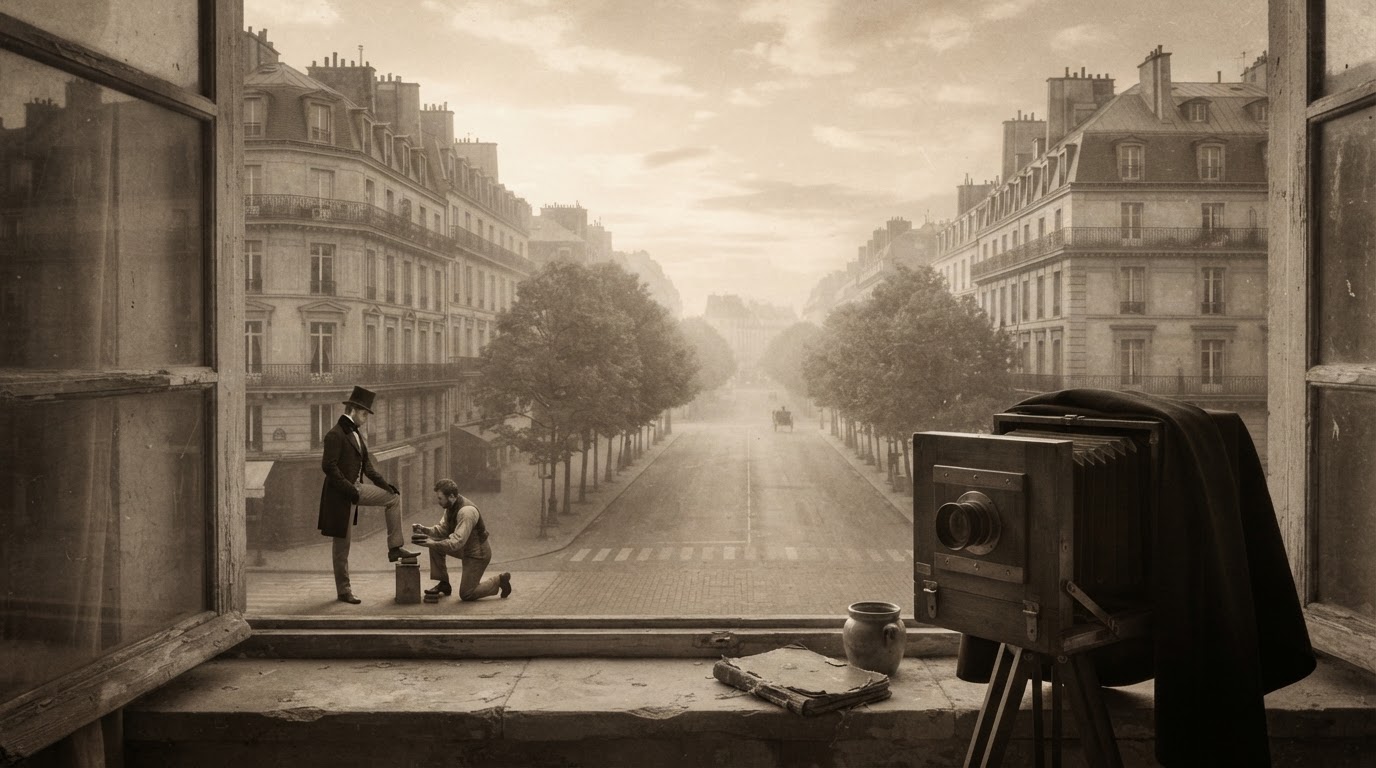
There is a photograph of a busy street in Paris, taken in 1838. It is often called the earliest known photograph of a human being.
But here is the funny part. The street was busy. Carriages. Horses. People walking. And almost none of them are in the picture.
The man who made it was Louis Daguerre. He was born on November 18, 1787, in a small town near Paris.
Daguerre was a showman first. He painted huge stage scenery. He ran a popular attraction in Paris called the Diorama, where giant paintings seemed to change from day to night as the lights shifted behind them. People paid to come and be amazed.
But he wanted something more. He wanted to catch light itself and make it stay.
After years of trying, he found a way. He used a thin sheet of copper coated with silver, treated it with chemicals, and let light shine on it through a camera. The result was a sharp, delicate picture. We call it a daguerreotype.
There was one catch. The plate needed light for several minutes to make a picture.
So when Daguerre pointed his camera out the window at the Boulevard du Temple, everything that moved was too fast to be caught. The carriages rolled right out of history. The crowds vanished.
Except for one man.
Down on the sidewalk, a man was having his boots shined. He stood still long enough, one foot up, for the light to remember him. You can just make out the person shining his shoes, too.
Lots of people walked that street that day. One man paused. And he is the one we can still see, almost two hundred years later.
I keep coming back to that.
So much of life feels like that busy street. Rushing. Moving. And at the end of the day we wonder where the hours went. Nothing stayed.
But the moments we stop for, those are the ones that stay with us.
A cup of coffee you actually taste. A conversation where you really listen. A child’s face, when you look up from your phone.
Stillness doesn’t make you smaller. It makes you visible.
In 1839, Daguerre’s process was announced to the world. The French government bought the rights and shared the method freely, so anyone could use it. Within a few years, people everywhere were sitting for portraits. They had to sit very, very still.
Maybe that is not the worst thing for us, either.
So here is your small invitation for this Wednesday. Find one minute to stand still. Not to get anything done. Just to be there.
Let the light find you.
Leave a Reply