


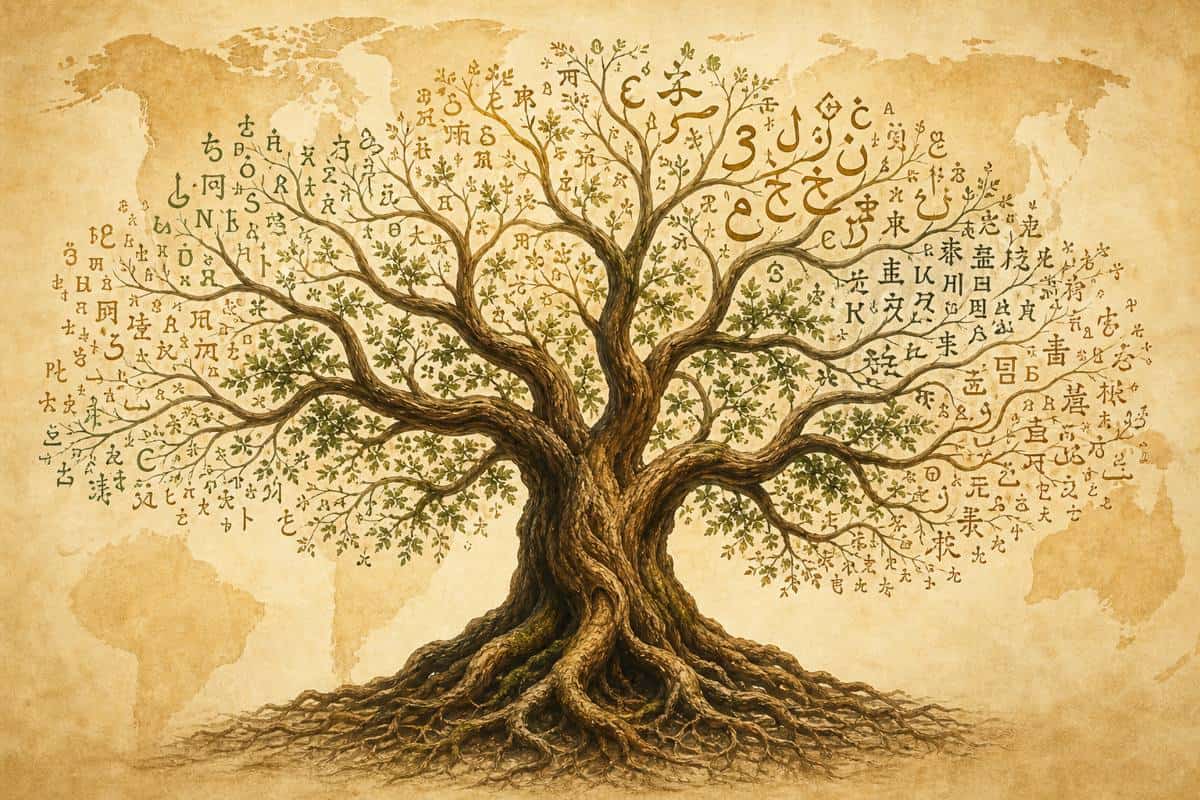
Languages can look like a collection of unrelated words until we step back and see the branches. English, Spanish, Arabic, Hindi, Japanese, Swahili, and thousands of other languages did not all grow from one recent trunk. They belong to different families, carry different histories, and sometimes influence one another so deeply that their relationships are easy to misunderstand.
A language family is a group of languages descended from a shared ancestral language. We usually cannot hear that ancestor spoken today. Linguists reconstruct parts of it by comparing patterns in vocabulary, sound changes, and grammar across its descendants.
A family is about ancestry—not appearance
Two languages may use the same alphabet without being close relatives. English and Vietnamese both use versions of the Latin alphabet, but they belong to different language families. Japanese uses kanji that originated in China alongside its own kana systems, yet Japanese is not simply a form of Chinese.
The reverse is also true. Related languages can be written differently. Hindi and Urdu are closely related in everyday speech, but standard Hindi is generally written in Devanagari while Urdu is written in a Perso-Arabic script. Writing is the clothing a language wears; ancestry is the family history underneath.
The Indo-European family
Many languages of Europe and a large part of South Asia belong to the Indo-European family. The name describes an enormous geographic reach, not a single culture. Its branches include Germanic, Romance, Slavic, Celtic, Greek, Baltic, Indo-Aryan, Iranian, Armenian, and Albanian.
Germanic languages
English is Germanic. Its closest historical structure comes from the languages brought to Britain by Germanic peoples. Dutch, German, Frisian, Danish, Norwegian, Swedish, Icelandic, and several other languages share this broad branch.
English can disguise its ancestry because centuries of contact brought in a tremendous amount of French, Latin, Greek, Norse, and vocabulary from languages around the world. Its everyday framework still reveals the Germanic foundation: words such as mother, father, house, water, come, and go, along with much of its basic grammar.
Romance languages
Spanish, Portuguese, French, Italian, Romanian, Catalan, and other Romance languages developed from varieties of spoken Latin. They are called Romance languages because of Rome, not because they are especially suited to candlelight and dinner—although French and Italian may protest that explanation.
Shared ancestry does not make the languages interchangeable. Pronunciation, grammar, vocabulary, and centuries of independent history give each one its own character. Speaking Spanish may make Portuguese, Italian, or French feel more familiar, but familiarity is only the beginning of learning.
Slavic languages
Russian, Ukrainian, Polish, Czech, Slovak, Bulgarian, Serbian, Croatian, Slovenian, and others belong to the Slavic branch. Some use Latin-based writing and others use Cyrillic, another reminder that an alphabet does not define a family.
The languages of India
There is no single “Indian language.” India is one of the most linguistically diverse places in the world. Hindi, Bengali, Marathi, Punjabi, Gujarati, Urdu, and many other languages belong to the Indo-Aryan branch of Indo-European. Tamil, Telugu, Kannada, and Malayalam belong to the separate Dravidian family. India is also home to Austroasiatic, Tibeto-Burman, and other languages.
Calling all of these “Indian” may describe nationality or geography, but it does not explain their linguistic relationships. The distinction matters because language is tied to literature, family, education, worship, memory, and identity.
Families beyond Indo-European
The European branches are only part of the global story. A truly useful language tree has to stretch much farther.
- Afro-Asiatic includes Arabic, Hebrew, Amharic, Hausa, and many other languages across North Africa, the Horn of Africa, the Sahel, and Southwest Asia. Arabic itself includes Modern Standard Arabic and numerous regional spoken varieties.
- Sino-Tibetan includes Mandarin, Cantonese and other Chinese varieties, as well as Tibetan, Burmese, and many additional languages.
- Japonic includes Japanese and the Ryukyuan languages. Japanese is not classified as a Chinese language merely because it adopted Chinese characters.
- Koreanic includes Korean and its historical varieties. Hangul is a writing system created for Korean, not a separate language.
- Turkic includes Turkish, Azerbaijani, Kazakh, Uzbek, Kyrgyz, and related languages spread across a vast region.
- Austronesian stretches from Madagascar through Island Southeast Asia and across the Pacific, including Indonesian, Malay, Tagalog, Māori, Hawaiian, and many others.
- Niger-Congo includes an extraordinary number of African languages, among them Yoruba, Igbo, Zulu, Xhosa, and the Bantu branch that includes Swahili.
These labels are maps, not boxes. Scholars continue to debate some classifications, and a broad family name can contain hundreds of communities with very different experiences.
What about language isolates?
Some languages have no demonstrated living relatives. These are called language isolates. Basque, spoken in parts of Spain and France, is a well-known example. “Isolate” does not mean primitive, incomplete, or lonely. It means researchers have not established a genealogical relationship to another surviving language.
Signed languages have families too
Signed languages are full natural languages with their own grammar and history. They are not visual copies of the spoken language surrounding them. American Sign Language and British Sign Language, for example, are not mutually understandable simply because both communities live in English-speaking countries. Signed languages also develop relationships, borrow, change, and form families.
Why the family tree matters
A language family tree helps us predict where vocabulary or grammar may feel familiar, but it also teaches humility. Languages travel through conquest, trade, migration, scholarship, faith, marriage, work, and ordinary neighborhood life. They borrow from one another without surrendering their identities.
English is a perfect example: Germanic in ancestry, transformed by French and Latin, enriched by contact across the world, and still changing every day. Its vocabulary is less like a sealed family album and more like a busy kitchen table where relatives, visitors, and unexpected guests have all left something behind.
Learning where languages come from does more than organize names. It helps us see the movement of people, ideas, and memory across generations.
Next in this series, we will look more closely at which languages tend to be easier for English speakers—and why “easy” depends on more than vocabulary alone.
Leave a Reply