


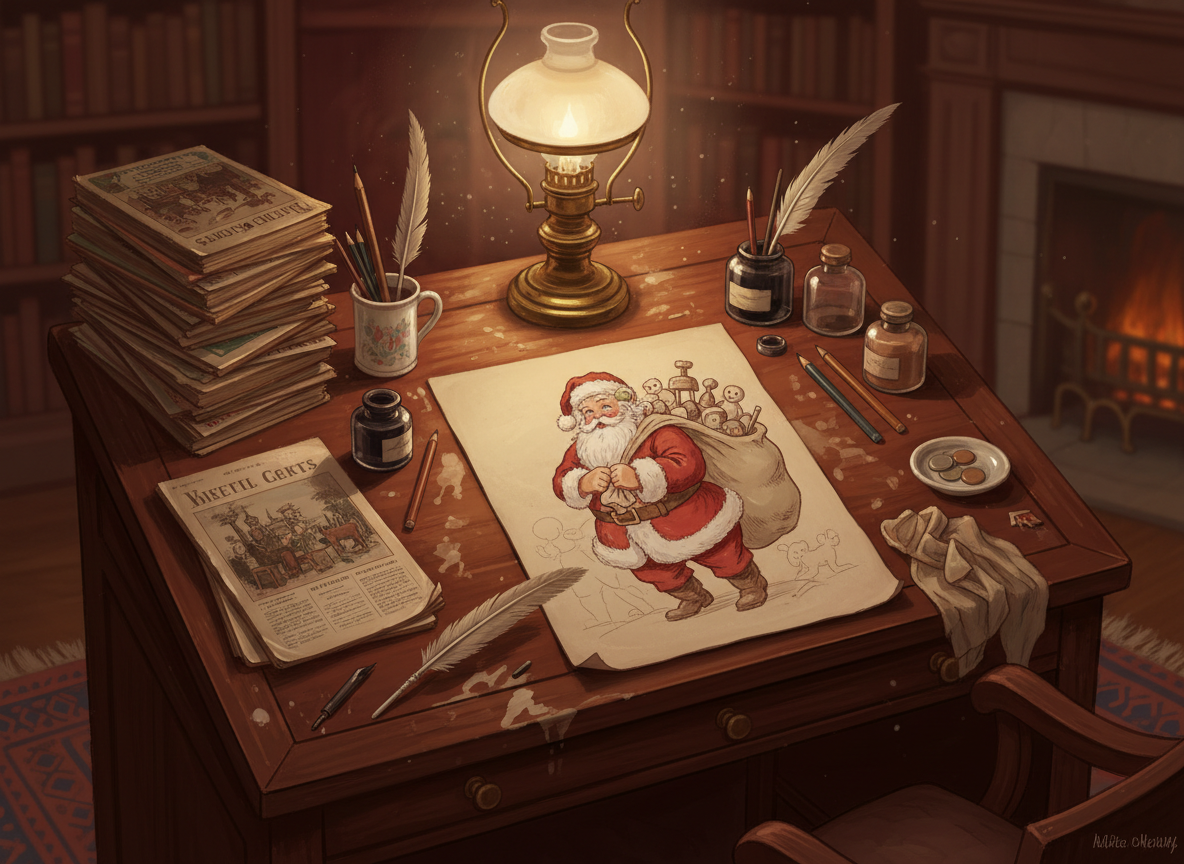
Close your eyes and picture Santa Claus.
Round belly. White beard. Red suit trimmed in white fur. Black boots. A sack of toys over one shoulder.
You didn’t invent that picture. Almost nobody alive today did. You inherited it, whole, from a German-born cartoonist named Thomas Nast, who was born on this day, September 27, 1840, in a town called Landau.
Nast came to New York as a boy of six, barely spoke English, and grew up to become the most famous illustrator in America. He worked for a magazine called Harper’s Weekly, drawing the news of the day in ink instead of words. During the Civil War, in 1863, he was asked to draw something to lift the spirits of a country tearing itself apart. He drew Santa Claus visiting Union soldiers in camp.
It wasn’t the first picture of Santa Claus. There’d been a poem, decades earlier “‘Twas the night before Christmas” that gave Santa a sleigh and eight reindeer and a round little belly that “shook when he laughed like a bowl full of jelly.” But nobody had drawn him yet, not really, not the way we’d recognize him now.
Nast kept drawing him. Christmas after Christmas, for over twenty years, he kept coming back to that same jolly, round, fur-trimmed figure, refining him a little more each time, until the sketch in his head became the picture in everybody else’s.
He never once meant to invent a tradition. He was just doing his job, on deadline, year after year, for a magazine that needed a Christmas cover.
Here’s something else worth knowing about him. Nast used that same pen to take down one of the most corrupt political machines New York City had ever seen. His cartoons made a crooked, powerful boss so instantly recognizable, so plainly ridiculous, that the boss reportedly begged his own men to stop the drawings from spreading — not the newspaper articles, the drawings. Nast’s constituents, he said, couldn’t read. But they could see a picture just fine.
That detail has stayed with me since I first read it. A drawing can reach somebody a paragraph never will. A picture doesn’t ask you to be educated first, or patient first, or in the right mood first. It just lands, all at once, the way a face does.
I think that’s worth remembering if you make anything with your hands — a photograph, a card, a little painted sign, a quilt, a candle wrapped in the right color of paper. You might think of it as decoration. Something extra. Not the real work.
But Nast thought he was drawing a magazine cover to fill space before a deadline. He had no idea he was quietly building the single most recognizable face of the whole Christmas season, one it turns out an entire country was hungry for and didn’t know how to picture until he handed it to them.
You don’t always get to know, while you’re making something, whether it’s just filling space or whether it’s the thing people will still be picturing a hundred and sixty years from now.
Make it anyway. Draw the sketch. Finish the card. Wrap the gift with care nobody asked you for.
Somebody, someday, might close their eyes and see exactly what you made.

Leave a Reply