


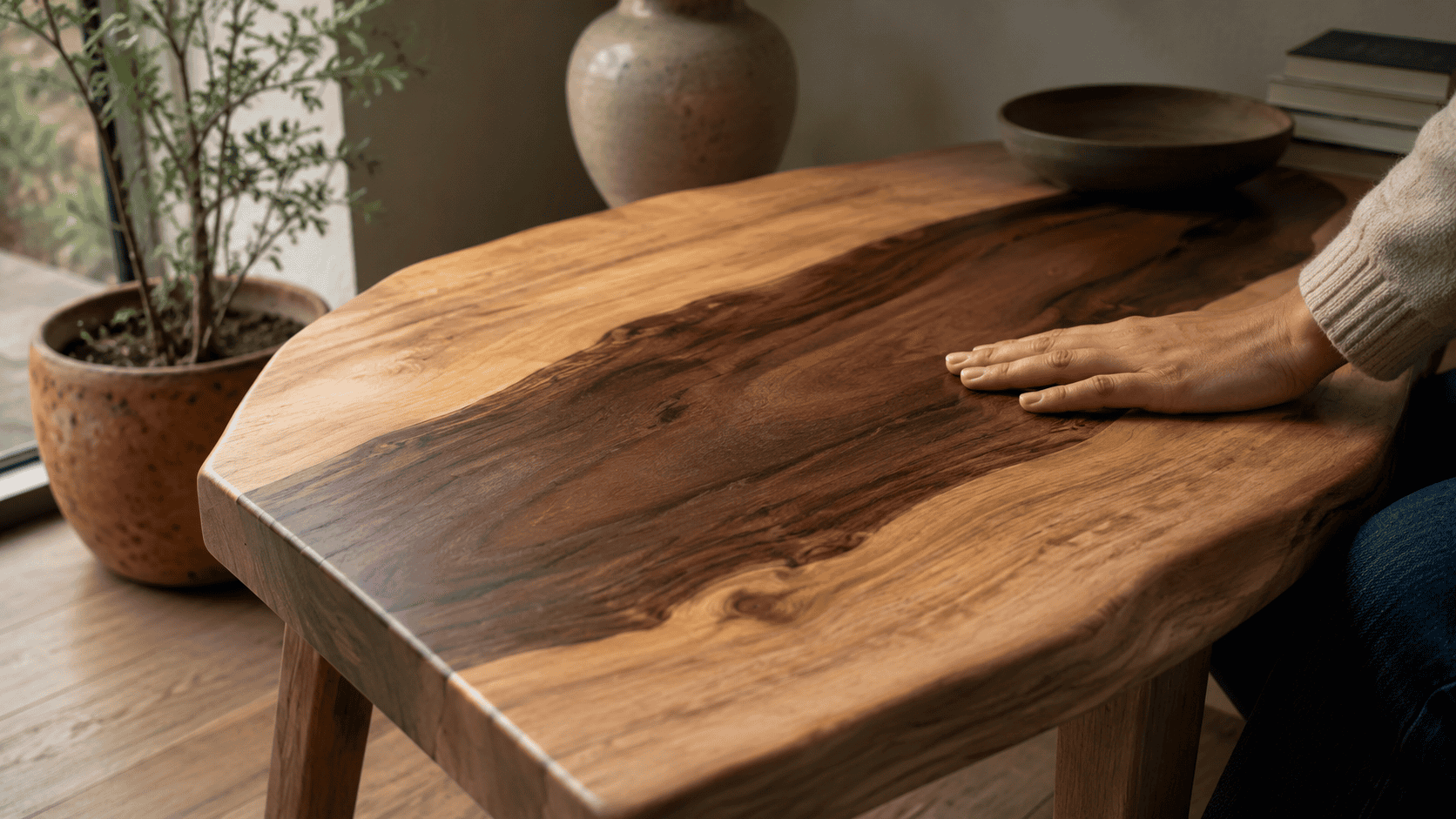
Have you ever run your hand across a wooden tabletop and noticed those long, wavy lines flowing through the wood? We call that grain. Most of us just think it’s pretty. It is pretty. But it’s not decoration. It’s the tree’s own construction plan, still visible, years after the tree stopped growing.
Once you know what grain actually is, you can’t unsee it.
Grain is just cells lined up in a row.
A tree is built out of millions of tiny, tube-shaped cells, and almost all of them grow pointing the same direction: straight up and down the trunk, from root to branch tip. Grain is simply what we call that lineup. When you look at a board and see lines running along its length, you’re looking at the direction those cells grew.
Why line up at all? Because those long thin cells are doing two jobs at once. They’re carrying water up from the roots to the leaves, the way a bundle of drinking straws would. And they’re holding the tree upright against wind and its own weight. Both jobs work better when the cells run long and straight, end to end, rather than every which way. A tree built out of jumbled, sideways cells couldn’t stand up straight or move water very far. Grain is the tree solving two problems with one shape.
The rings you see are grain, too.
Remember those growth rings we’ve talked about before? Grain and growth rings are actually part of the same story. In spring, a tree grows fast, so it builds bigger, thinner-walled cells. That wood is lighter in color. In summer, growth slows down, and the tree builds smaller, thicker-walled cells packed closer together. That wood is darker and denser. Line those bands up year after year, and you get rings. Cut the log a different way, and those same bands become the long, flowing grain lines you see on a board.
So grain and rings aren’t two separate patterns. They’re the same growth story, just sliced in different directions.
Sometimes the story twists.
Most trees grow their cells straight up and down, but some don’t. In certain trees, the cells spiral slightly around the trunk instead of running dead straight, a bit like the stripes on a barber pole. Scientists call this spiral grain, and honestly, they’re still not completely sure why some trees do it. One leading idea is that it helps water reach every branch evenly, even if part of the root system gets damaged. Another is that it helps the tree flex and resist twisting in strong wind, almost like reinforcing thread woven at an angle.
Some trees take it even further. Their grain spirals one way for a while, then reverses and spirals the other way, back and forth, year after year. That’s called interlocked grain, and it makes the wood remarkably hard to split. Ever notice how some woods are nearly impossible to split cleanly with an axe, no matter how sharp it is? That stubbornness is often interlocked grain at work, doing exactly what it did for the living tree: resisting anything that tries to tear it apart in a straight line.
Why a woodworker cares so much about grain direction.
This is the part that connects straight back to the workshop. Grain direction isn’t just something to admire. It’s something a woodworker has to read and respect, every single time they pick up a tool.
Cut or plane along the direction the grain runs, and the tool glides, leaving a clean, smooth surface. Fight the grain, cutting against it, and the wood tears and splinters instead of slicing cleanly. That’s why you’ll hear woodworkers talk about working “with the grain.” They’re not being poetic. They’re describing a real, physical difference between wood that cooperates and wood that fights back.
Grain also affects strength. A board is strongest along the length of its grain and much weaker across it, which is exactly why a chair leg is cut so the grain runs up and down the leg, not sideways through it. Cut it the wrong way, and a piece that looks identical can snap under weight that should never have broken it.
A tree’s fingerprint, hiding in plain sight.
Every board carries its own particular grain pattern, shaped by exactly how that individual tree grew: how fast, how straight, how much wind it leaned into, how crowded its neighbors were. No two boards are ever really the same, even from the same tree, even from the same species.
So the next time you notice those lines running through a wooden table or a chair back, you’re not just looking at a nice pattern. You’re looking at how that tree grew, cell by cell, for every year it stood. It’s a small thing. But it’s the kind of small thing worth stopping to really look at.
SOURCES
– The Wood Database — Wood Grain/Texture
– USDA Forest Products Laboratory — Wood Handbook, Chapter 3: Structure and Function of Wood
– The Gymnosperm Database — Why Do Trees Form Spiral Grain?
– Canadian Woodworking — The Truth About Wood Grain
– Hobbit House Inc. — Interlocked Grain reference
Leave a Reply