


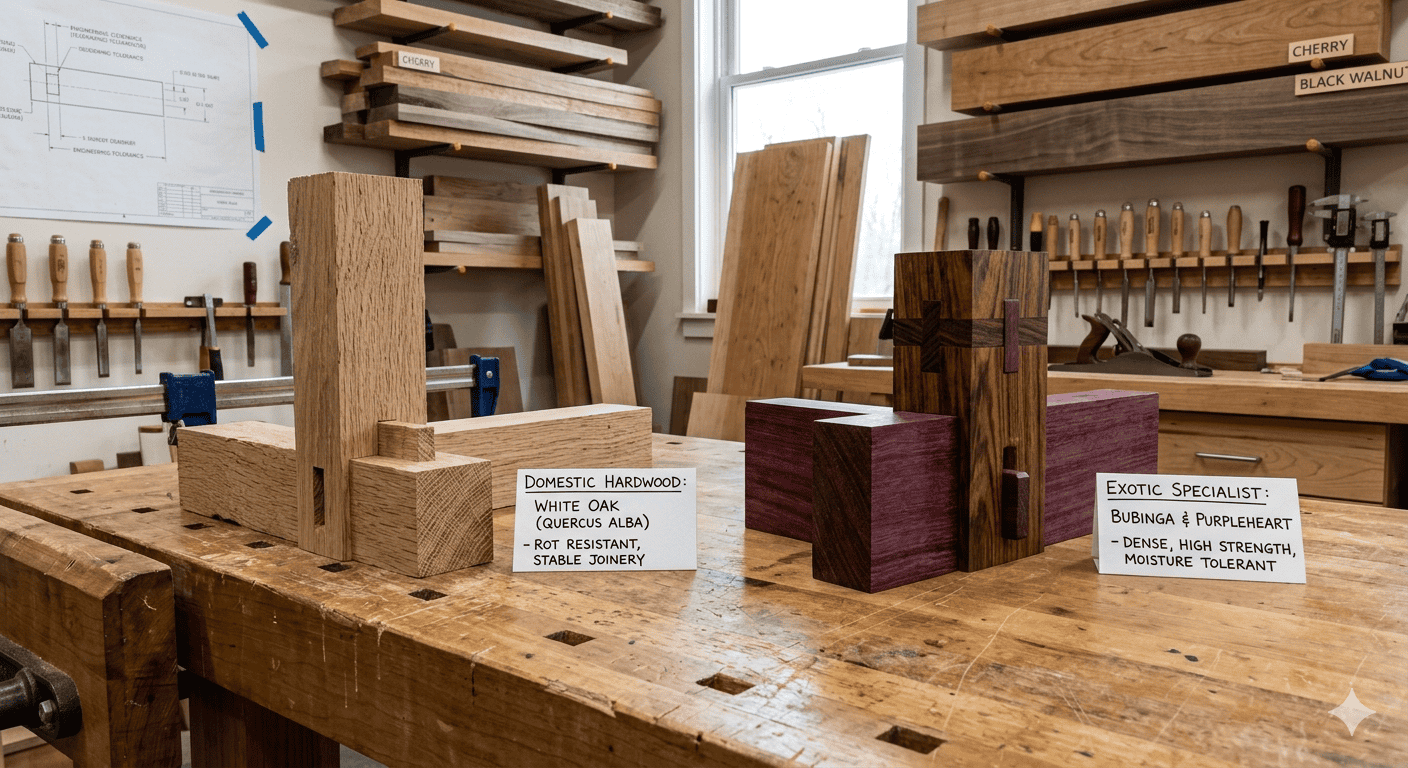
In the world of professional engineering, material selection is dictated by the mission. You don’t specify a low-alloy steel where corrosion resistance is the primary constraint. Woodworking, specifically in the American Traditional style, requires the same analytical rigor. At All About You, we refer to this as “Material Intelligence.”
When we select timber for a commission, we aren’t just looking for a pretty face. We are auditing the wood’s structural history. Domestic hardwoods like White Oak, Black Walnut, and Cherry are the “Project Managers” of our workshop. They are chosen because their coefficients of expansion are well-documented and their structural integrity in temperate climates is unparalleled.
White Oak, for instance, is the bedrock of durability—its cellular structure is naturally “plugged” with tyloses, making it resistant to rot and remarkably stable under load. Walnut offers a strength-to-weight ratio that makes it the ideal candidate for refined joinery. These woods are reliable; they play well with traditional joinery, ensuring that a tenon cut today will stay seated for a century.
However, a sophisticated design often requires a “Specialist.” This is where Exotic Woods enter the conversation. We don’t use woods like Bubinga or Teak for the sake of a name; we use them for their specific physical properties. Teak, with its high natural oil content, is a tactical choice for moisture-heavy environments. A dense exotic like Purpleheart or Wenge might be used as a structural accent—like a peg or a spline—because its extreme hardness provides a mechanical advantage where a domestic wood might shear.
The novice chooses wood by the color. The craftsman chooses wood by the behavior. By matching the mechanical properties of a species to the functional requirements of the piece, we ensure that the beauty isn’t just skin deep—it is engineered to endure.
Leave a Reply