


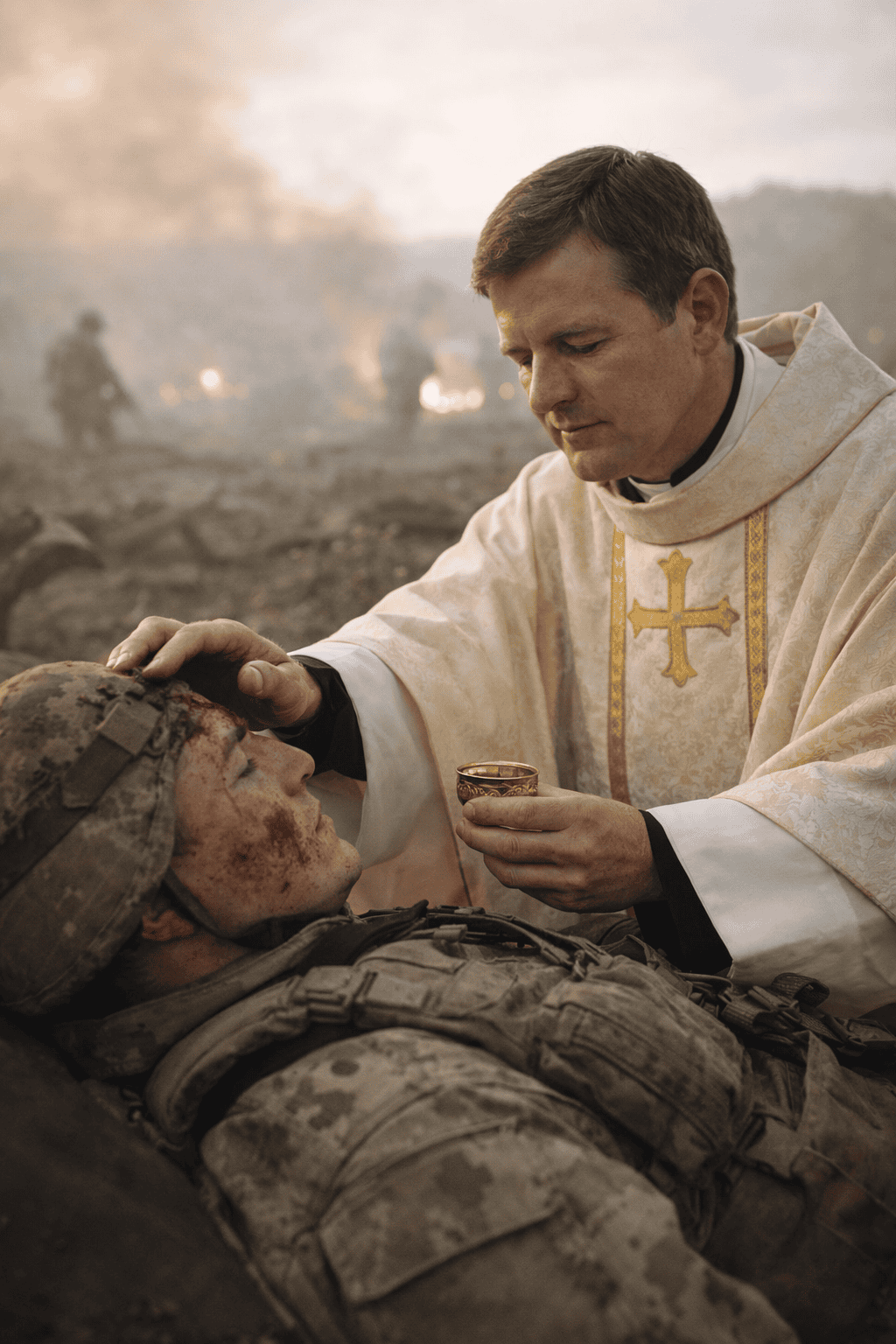
There is a moment in life that most people do not want to think about.
The moment when strength fades.
When control slips away.
When what lies ahead is no longer in our hands.
Lent begins by reminding us of something we often try to avoid:
“You are dust, and to dust you shall return.”
(Genesis 3:19)
That truth is not meant to frighten us. It is meant to prepare us.
From the earliest days of the Church, Christians did not face that moment alone.
The Beginning of the Practice
The Letter of James gives one of the clearest instructions:
“Is any among you sick? Let him call for the elders of the Church, and let them pray over him, anointing him with oil in the name of the Lord.”
(James 5:14)
This was not symbolic language. It was a practice.
The elders—what we now understand as priests—were called to come to the sick, to pray, and to anoint them.
James continues:
“The prayer of faith will save the sick man, and the Lord will raise him up; and if he has committed sins, he will be forgiven.”
(James 5:15)
From the beginning, the Church understood that this moment involved both healing and forgiveness.
Not one or the other.
Both.
What the Church Brings
Over time, this practice developed into what we now call the Last Rites.
It is not a single sacrament.
It is a gathering of three:
- Confession — so that nothing remains unresolved
- Anointing of the Sick — for strength, peace, and grace
- Viaticum (the Eucharist) — food for the final journey
The word viaticum means exactly that: provision for the journey.
The Church does not send a person toward death empty.
She sends them with Christ.
The Early Church
The early Church took this seriously.
Writings from the first centuries show that Christians were anointed when they were ill and prayed over by the community. Oil, already a sign of healing and consecration, became a visible sign that God was present even in weakness.
There was no sense that suffering meant abandonment.
There was no sense that death meant separation.
Christ had already entered into both.
What Has Not Changed
Today, many people associate Last Rites only with the final moments of life.
But the Church has always understood it more broadly.
The Catechism states:
“The Anointing of the Sick is not a sacrament for those only who are at the point of death.”
(CCC 1514)
It is given whenever serious illness or weakness begins to take hold.
But when death does approach, the Church gathers everything together.
Nothing is left undone.
Nothing is left unsaid.
The Quiet Reality
There is something different about this moment.
It is quieter than the others.
There are no crowds.
No processions.
No outward celebration.
A priest comes.
He prays.
He anoints.
He gives the Eucharist.
And in that quiet, something real takes place.
Strength is given.
Peace settles.
Sometimes there is physical healing.
Often there is something deeper—a readiness, a calm, a return.
The Meaning of the Moment
Christ did not avoid suffering.
He entered into it.
He did not remain distant from death.
He passed through it.
Because of this, the final moments of life are no longer empty.
They are not simply an ending.
They become a place of encounter.
St. Paul writes:
“If we have died with him, we shall also live with him.”
(Romans 6:8)
This is not a distant promise.
It is the reality the Church places before the faithful in their final moments.
Lent and the Final Return
Lent leads us here.
It begins with ashes and moves steadily toward the Cross.
Along the way, we are reminded:
We are not in control.
We are not self-sustaining.
We are not permanent.
And yet we are not abandoned.
The sacraments reveal this step by step.
Baptism begins life in Christ.
Confession restores it.
The Eucharist nourishes it.
Confirmation strengthens it.
Holy Orders serves it.
And in the end—
Last Rites entrusts it back to God.
The Church Remains
At the final moment, when everything else falls away, the Church does not step back.
She steps closer.
She brings prayer.
She brings forgiveness.
She brings oil.
She brings Christ.
Not as memory.
But as presence.
Lent is not about returning to the past.
It is about returning to God.
And in the final moment, the Church makes sure that return is not made alone.
References
Sacred Scripture
James 5:14–15
Genesis 3:19
Romans 6:8
Catechism of the Catholic Church
CCC 1499–1532
Early Church Witness
Hippolytus, Apostolic Tradition (c. AD 215)
Origen (3rd century references to anointing)
Leave a Reply