


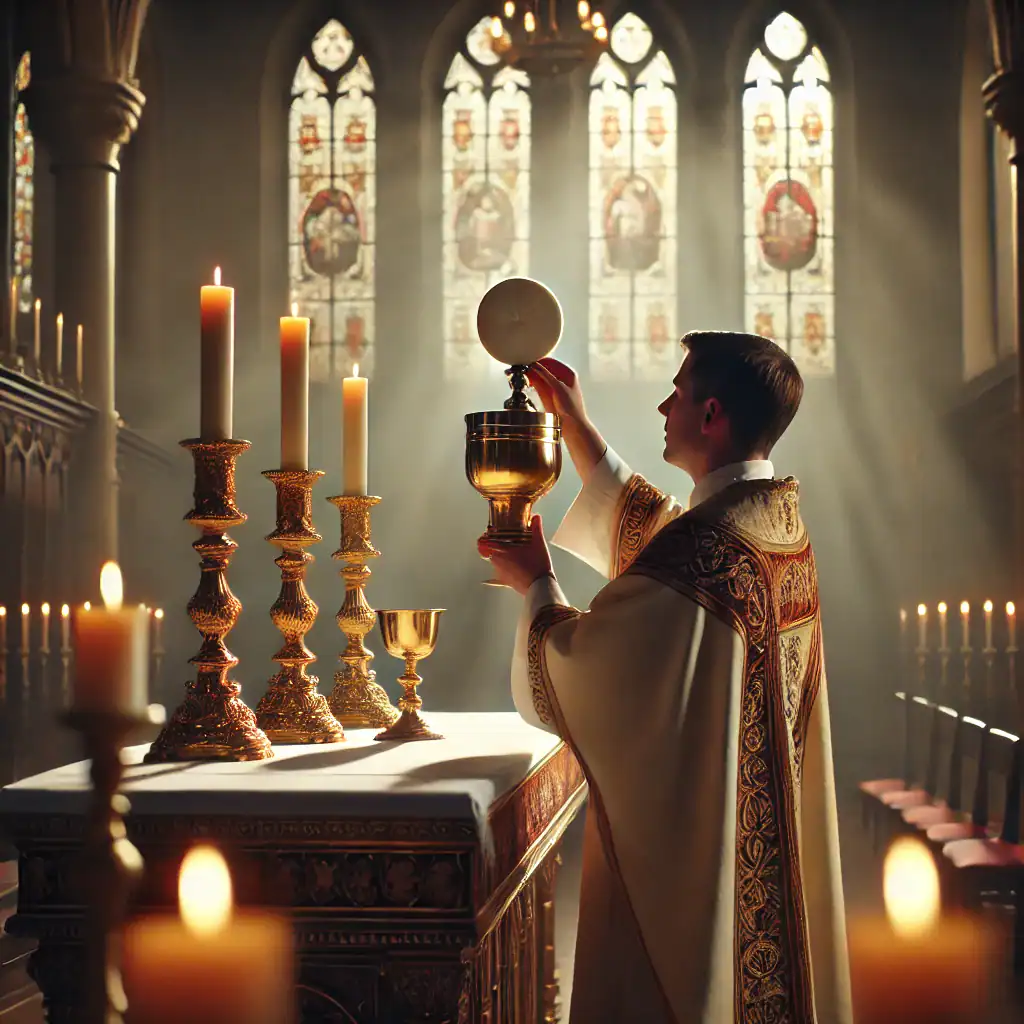
When Christians speak about the Eucharist, they are not speaking about a symbol or a reminder alone. From the earliest centuries of the Church, Christians believed that Christ Himself was present among them when they gathered to break the bread.
This belief did not develop slowly over time. It began with the words of Christ Himself.
At the Last Supper, on the night before His crucifixion, Jesus took bread, blessed it, and gave it to His disciples saying:
“Take, eat; this is my body.”
(Matthew 26:26)
Then He took the cup and said:
“Drink from it, all of you; for this is my blood of the covenant, which is poured out for many for the forgiveness of sins.”
(Matthew 26:27–28)
These words were not softened by the early Christians. They repeated them exactly as they had received them.
In fact, the Gospel of John shows that even during Christ’s own ministry many struggled to accept this teaching. When Jesus declared that His flesh was true food and His blood true drink, some of His followers responded with confusion and disbelief.
“This saying is hard; who can accept it?”
(John 6:60)
Some disciples even walked away. Yet Christ did not withdraw the teaching.
From the beginning, Christians understood that the Eucharist was more than a memorial meal. It was participation in the life of Christ.
Paul continues his warning with another striking statement:
“Anyone who eats and drinks without discerning the body eats and drinks judgment upon himself.”
(1 Corinthians 11:29)
This language reveals how seriously the earliest Christian communities treated the Eucharist. The bread and the cup were not approached casually. They required preparation, humility, and reverence.
This understanding did not belong to Paul alone. It appears throughout the earliest Christian writings outside the New Testament as well.
One of the earliest documents describing Christian worship is known as The Didache, written sometime between AD 70 and 100. This text gives practical instructions to early Christian communities and shows that the Eucharist was already central to their gatherings.
The Didache instructs believers to approach the Eucharist only after reconciling with one another:
“Let no one eat or drink of your Eucharist except those baptized in the name of the Lord.”
(Didache, Chapter 9)
Even in this early document, the Eucharist is treated as something sacred, something that belongs to the baptized community of believers.
As the Church grew, the early Christian leaders continued to speak about the Eucharist in language that reflected the words of Christ.
Around AD 107, St. Ignatius of Antioch, a bishop and disciple of the Apostle John, wrote a series of letters while being taken to Rome for execution. In one of these letters he warned against those who denied the reality of the Eucharist:
“They abstain from the Eucharist and from prayer because they do not confess that the Eucharist is the flesh of our Savior Jesus Christ.”
(Letter to the Smyrnaeans, 6–7)
Ignatius wrote these words only a few decades after the apostles. His testimony shows that the belief in Christ’s presence in the Eucharist was already firmly established.
A generation later, St. Justin Martyr described Christian worship to the Roman authorities in order to correct misunderstandings about Christian practices.
He explained:
“We do not receive these as common bread and common drink; but… the food which has been made into the Eucharist… is the flesh and blood of that incarnate Jesus.”
(First Apology, Chapter 66)
These explanations were necessary because outsiders had begun to misunderstand Christian worship. Hearing Christians speak of eating the body of Christ and drinking His blood, some Roman critics accused them of practicing cannibalism.
The accusation reveals something important. Christians were speaking about the Eucharist in language that sounded very literal to those outside the faith. They were not describing a symbol. They were repeating the words of Christ.
Yet Christians themselves understood that the Eucharist was a sacrament, not a physical act of eating flesh in the ordinary sense. Through the mystery of the sacrament, Christ becomes truly present under the appearances of bread and wine.
Another early bishop, St. Irenaeus of Lyons, writing around AD 180, explained this transformation in these words:
“The bread… having received the invocation of God, is no longer common bread but the Eucharist.”
(Against Heresies, Book IV)
By the fourth century this teaching was still clearly expressed. St. Cyril of Jerusalem, instructing catechumens preparing for Baptism during Lent, told them:
“Do not regard the bread and wine as simply that; for they are, according to the Lord’s declaration, the body and blood of Christ.”
(Mystagogical Catechesis, 4)
These instructions were given to those who were about to receive the Eucharist for the first time at Easter.
The seriousness of this belief becomes even clearer when we look at the history of Christian persecution.
In the early fourth century, during the Roman persecutions, Christians were forbidden to gather for worship. Roman authorities knew that the heart of Christian life was the Eucharist. If they could stop the Eucharistic assembly, they believed the Church itself would weaken.
In the year AD 304, a group of Christians in North Africa gathered secretly for Sunday worship despite the danger. When they were arrested and brought before the Roman authorities, they were asked why they had disobeyed the imperial order.
One of them responded with words that have been remembered ever since:
“Sine dominico non possumus.”
This phrase means:
“Without the Lord’s Day we cannot live.”
For these Christians, the Eucharist was not merely a ritual or tradition. It was the source of their spiritual life. To abandon it would have meant abandoning Christ Himself.
Many of them were executed for their refusal.
Stories like this reveal the depth of the early Christian conviction. The Eucharist was not treated as a symbol that could be replaced or postponed. It was the presence of Christ among His people.
This is why the Eucharist stands at the center of Christian life.
Baptism brings a person into the life of Christ. Confession restores that life when it has been wounded. The Eucharist nourishes that life continually.
Lent prepares the faithful to receive this gift more deeply.
Fasting awakens hunger. Prayer restores attention. Repentance clears away the obstacles that dull the heart. These practices are not meant simply as disciplines. They prepare the soul to approach the altar with reverence.
Because at the altar, Christians believe they encounter not merely a memory of Christ, but Christ Himself.
And this is why Lent leads us toward the Eucharist.
References
Sacred Scripture
1 Corinthians 11:27–29
Matthew 26:26–28
John 6:55–60
Early Christian Sources
The Didache (c. AD 70–100)
Ignatius of Antioch, Letter to the Smyrnaeans
Justin Martyr, First Apology
Irenaeus of Lyons, Against Heresies
Cyril of Jerusalem, Mystagogical Catecheses
Historical Witness
The Martyrs of Abitinae (AD 304)
Leave a Reply