


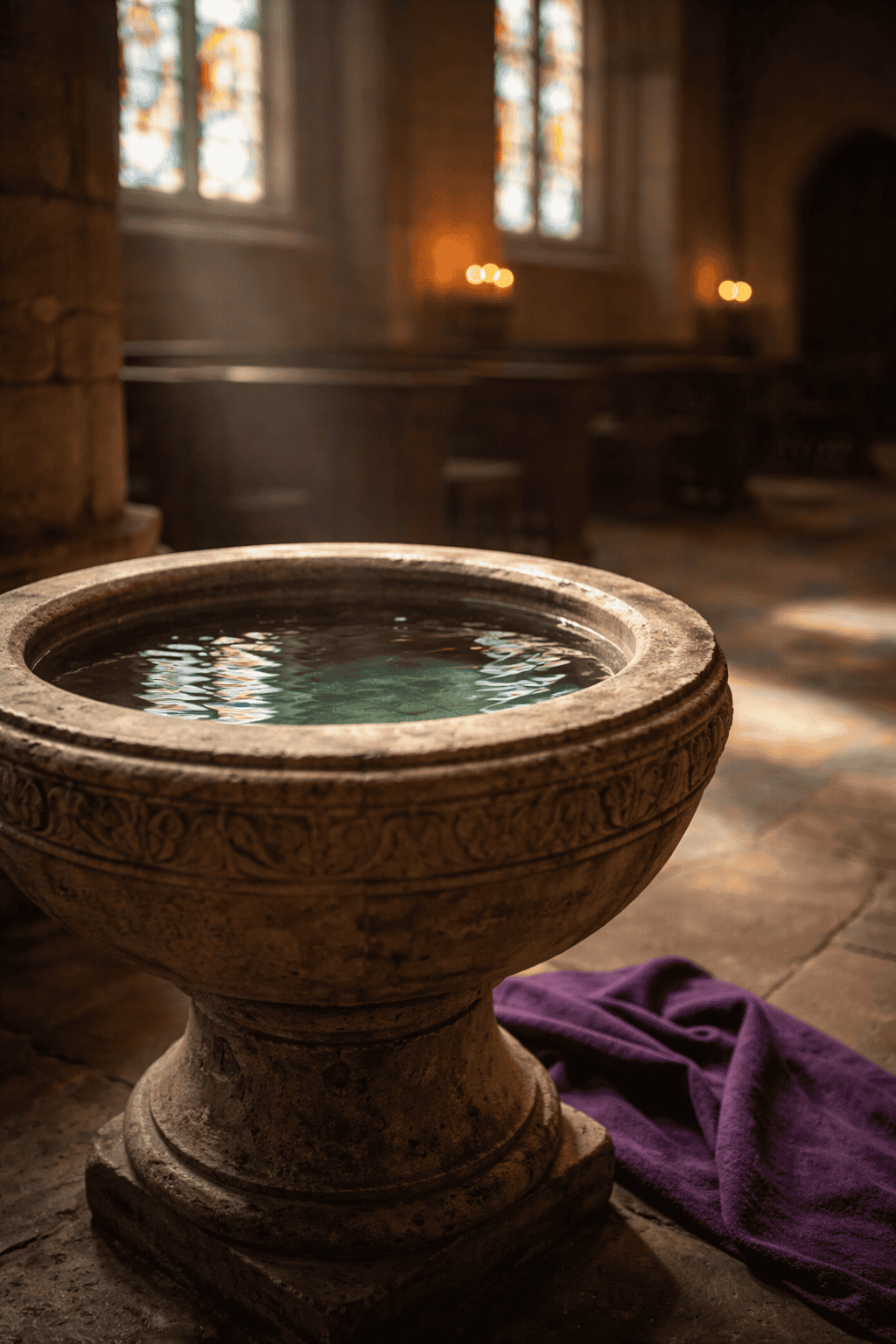
Baptism and Lent: Returning to the Beginning
Lent did not begin as a season for those already baptized. It began as preparation for those who were not.
This can be difficult to see now, because most Catholics today are baptized as infants. We do not remember it. We inherit it before memory forms. But in the earliest centuries of the Church, Baptism was something a person approached deliberately, after long preparation. And Lent was the Church’s final period of preparation before that moment.
Catechumens—those preparing to enter the Church—spent years learning the faith. They listened. They observed. They changed their lives gradually. But the final preparation happened during Lent. These forty days were not symbolic. They were intentional. They were the last purification before entering into something permanent.
At the Easter Vigil, in the darkness before Easter morning, they were baptized.
This timing was not accidental. Baptism was always understood as participation in the death and resurrection of Christ. It was not merely washing. It was burial and rising.
St. Paul writes:
“Do you not know that all of us who have been baptized into Christ Jesus were baptized into his death?”
(Romans 6:3)
This is difficult language if understood only symbolically. Baptism is not merely a reminder of Christ’s death. It unites the baptized person to it.
He continues:
“We were buried therefore with him by baptism into death, so that as Christ was raised from the dead… we too might walk in newness of life.”
(Romans 6:4)
The early Church took this seriously. Baptism was often administered through immersion. The person descended fully into the water, symbolizing burial. When they rose, it symbolized resurrection. They emerged from the water as someone new—not because their physical body had changed, but because their identity had.
Lent prepared them for this death.
Fasting loosened attachment to the former life. Prayer established dependence on God. Instruction formed understanding. Lent was not deprivation for its own sake. It was preparation for transformation.
Over time, as Christianity spread and families entered the Church together, infant baptism became more common. Children were baptized before they could understand what was happening. This did not change the meaning of Baptism, but it changed how Lent was experienced. Fewer adults were preparing to be baptized themselves.
Yet Lent remained.
Its purpose expanded. Instead of preparing individuals for Baptism, it became preparation for the renewal of Baptism.
Because Baptism does not fade. But memory can.
Christ Himself revealed the importance of Baptism at the beginning of His public ministry. Though He had no sin, He entered the waters of the Jordan. John hesitated, recognizing that Christ did not need repentance. But Christ insisted. When He rose from the water, the heavens opened, and the Father declared:
“This is my beloved Son, with whom I am well pleased.”
(Matthew 3:17)
Christ entered the water not because He needed purification, but because we did. He sanctified the waters so that they would become the means by which others would later be united to Him.
From that moment forward, Baptism became the gateway.
The Church has always preserved this understanding. The Catechism teaches:
“Holy Baptism is the basis of the whole Christian life, the gateway to life in the Spirit, and the door which gives access to the other sacraments.” (CCC 1213)
Baptism is not one sacrament among many. It is the entrance. Without it, the others cannot be received.
Ash Wednesday begins Lent with a reminder:
“You are dust, and to dust you shall return.”
(Genesis 3:19)
This is the truth of human life. Mortality cannot be escaped. Left to itself, dust returns to dust.
Baptism answers that truth.
It does not remove mortality. Christians still die. But it changes death’s meaning. Through Baptism, the believer is united to Christ’s death so that they may also be united to His resurrection.
This is why Lent and Baptism remain connected.
At the Easter Vigil each year, the Church renews baptismal promises. The faithful reject sin again. They profess faith again. Not because Baptism must be repeated—it cannot be—but because its meaning must be remembered.
Lent clears away what obscures identity.
It reveals attachments that have grown quietly. It restores clarity where distraction has settled. It prepares the soul not to be baptized again, but to live consciously as one who already has been.
In the early Church, catechumens walked through Lent toward Baptism. Today, the baptized walk through Lent toward remembrance.
The structure has developed across centuries. The discipline has adjusted. But the purpose has remained steady.
Baptism establishes identity.
Lent restores awareness of it.
Christ said:
“Unless one is born of water and the Spirit, he cannot enter the kingdom of God.”
(John 3:5)
This birth happens once.
But its meaning unfolds across a lifetime.
Lent brings us back to the beginning.
Not to repeat it.
But to remember who we became there.
References
Sacred Scripture (Ignatius Catholic Study Bible)
Romans 6:3–4
Matthew 3:13–17
John 3:5
Genesis 3:19
Catechism of the Catholic Church
CCC 1213
CCC 1226–1227
CCC 1254
Early Church Sources
Hippolytus of Rome, Apostolic Tradition, c. AD 215
St. Cyril of Jerusalem, Catechetical Lectures, 4th century
Historical Liturgical Studies
Thomas J. Talley, The Origins of the Liturgical Year
Joseph A. Jungmann, The Early Liturgy to the Time of Gregory the Great
Leave a Reply