

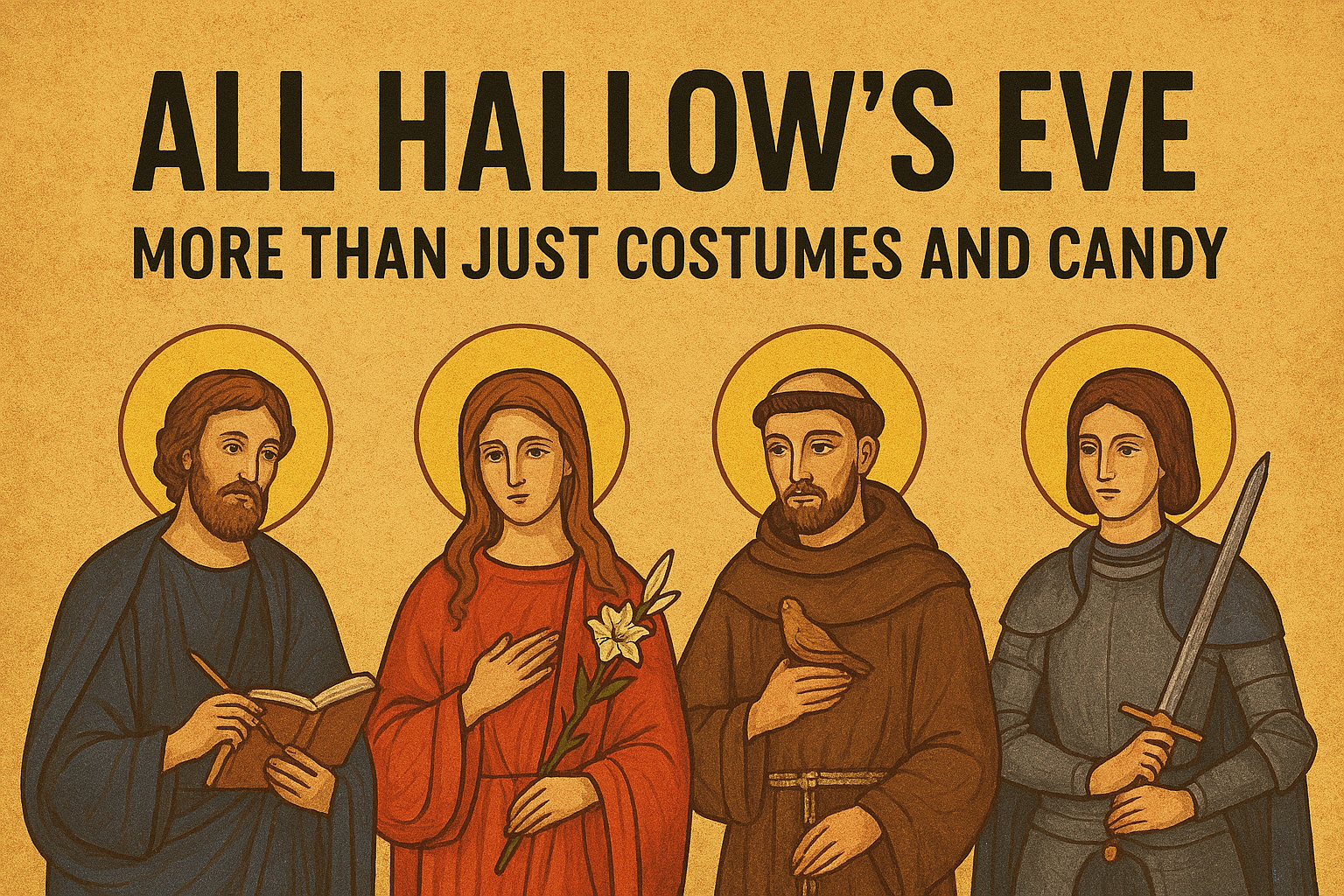
Before Halloween became a parade of pumpkins, pirates, and fog machines, it was known as All Hallow’s Eve, the vigil that begins the sacred trio of days known as Hallowtide. October 31st marked the eve of All Saints’ Day (November 1st), followed by All Souls’ Day (November 2nd). Together, these days were set aside to honor the saints, remember the departed, and reflect on the mystery of life, death, and resurrection.¹
What All Hallow’s Eve Was Really About
Before it was costumes and candy, All Hallow’s Eve was a night of prayer, mercy, and remembrance.
In the early Church, this sacred vigil prepared the faithful for All Saints’ Day, a feast honoring all the saints, known and unknown. It was never created to replace pagan festivals like Samhain. In fact, the Feast of All Saints developed independently within Christian communities as early as the 4th century AD.²
- Edessa observed a feast for all martyrs on May 13, as recorded in the Syriac Martyrology of 411 AD.
- Antioch celebrated it on the first Sunday after Pentecost, a tradition still followed in the Eastern Orthodox Church.
- In 609 or 610 AD, Pope Boniface IV consecrated the Roman Pantheon to the Virgin Mary and all martyrs, establishing May 13 as the Roman feast of All Saints.³
- Pope Gregory III (reigned 731–741 AD) moved the date to November 1st when he dedicated a chapel in St. Peter’s Basilica to all saints.⁴
- Pope Gregory IV (reigned 827–844 AD) extended the observance to the entire Western Church.⁵
The overlap in timing with Samhain is coincidental, not causal. The Church did not “baptize” paganism; it built its own rhythm of remembrance and hope.

Saints and the Sacred Vigil: How the Early Church Kept All Hallow’s Eve
All Hallow’s Eve was never about fear or spectacle. It was about connection between the living and the dead, the Church on earth and the Church in heaven. It was a night of prayer, mercy, and remembrance, preparing hearts for the joy of All Saints’ Day.
Children and families often honored saints whose stories inspired courage, compassion, and faith. These saints weren’t distant icons. They were companions in the journey of faith, and their lives were remembered in ways both reverent and joyful:
🕊️ Evangelists and Apostles
- St. Matthew, St. Mark, St. Luke, St. John
(Symbols: books, scrolls, quills are reminders of the Gospels they gave us)
🌹 Women of Courage
- St. Mary Magdalene, St. Lucy, St. Cecilia, St. Clare of Assisi
(Symbols: lilies, lamps, musical instruments, veils are signs of purity, witness, and devotion)
🛡️ Saints of Strength and Service
- St. Francis of Assisi, St. Dominic, St. George, St. Joan of Arc
(Symbols: animals, rosaries, swords, armor are emblems of peace, prayer, and holy courage)
In medieval Europe, children would dress as these saints and go door to door, reciting prayers or hymns in exchange for soul cakes which were small pastries given in return for prayers for the dead.⁶ It was a joyful, embodied way to teach virtue and devotion.
The vigil itself was marked by sacred practices:
- Vespers and Vigils: Churches and monasteries held evening services with psalms, Scripture readings, and the chanting of the Office of the Dead.
- Visiting Graves: Families cleaned and decorated graves, lit candles, and offered prayers for the departed.
- Almsgiving and Hospitality: Acts of mercy such as feeding the poor, giving alms, welcoming strangers—were central to the season.
These traditions were not only devotional. They were formative. They taught the young and old alike to remember the saints, pray for the dead, and live lives of mercy and hope.
Not an Evil Holiday…But a Sacred Vigil
Some believe Halloween is rooted in darkness. But the truth is far older and far holier. All Hallow’s Eve began as a sacred vigil, preparing the heart for the celebration of the saints. The “spooky” symbols such as skeletons, fog, costumes were not born of malice, but of metaphor. Skeletons reminded Christians of mortality (Psalm 90:10), fog evoked mystery (1 Corinthians 13:12), and costumes symbolized transformation (Romans 12:2). These were visual echoes of deeper truths: that life is fleeting, death is not the end, and in Christ, we are made new.
Even today, when Halloween is often commercialized or misunderstood, its origins still hold space for reverence. The vigil of October 31st was never meant to glorify fear. It was meant to honor faith, remember the departed, and prepare for the joy of resurrection.⁷
A Simple Blessing for Hallowtide
May this Hallowtide remind you of those who came before,
the saints who inspire,
the souls who shaped your story,
and the love that connects us all.
May your days be bright,
your nights peaceful,
and your heart comforted by knowing you are never alone.
May the saints cheer you on,
the angels walk beside you,
and God’s love hold you through every season.
📚 Footnotes
¹ Hallowtide includes All Hallow’s Eve (Oct 31), All Saints’ Day (Nov 1), and All Souls’ Day (Nov 2).
² The earliest known collective feast for all martyrs was celebrated in the Eastern Church in the 4th century. Edessa observed it on May 13, as recorded in the Syriac Martyrology of 411 AD.
³ Pope Boniface IV consecrated the Roman Pantheon to the Virgin Mary and all martyrs in 609 or 610 AD, establishing May 13 as the Roman feast of All Saints.
⁴ Pope Gregory III (731–741 AD) moved the feast to November 1st when he dedicated a chapel in St. Peter’s Basilica to all saints.
⁵ Pope Gregory IV (827–844 AD) extended the observance to the entire Western Church.
⁶ Soul cakes were small pastries given to children or the poor in exchange for prayers for the dead.
⁷ The symbolic use of skeletons, fog, and costumes in Christian tradition reflects deeper theological truths: mortality (Psalm 90:10), mystery (1 Corinthians 13:12), and transformation (Romans 12:2).
🔍 Sources for Further Reading
- Catholic Encyclopedia – All Saints’ Day
- Catholic Exchange – The Origins of Halloween & All Saints Day
- OSV News – The History Behind All Saints’ and All Souls’ Days
- Carrick Mór – The Irish Origins of All Hallows’ Eve

Leave a Reply