
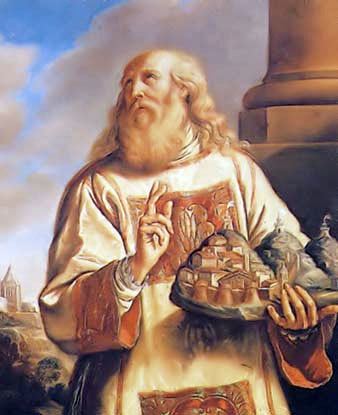
In the quiet folds of Christian history, some saints are remembered not for miracles or martyrdom, but for the sanctity of their silence. Saint Marinus is one such figure—a man whose legacy was carved not in spectacle, but in stone. Born in the late third century on the island of Rab, off the coast of modern-day Croatia, Marinus fled persecution and built a life of refuge and integrity. From his solitary chapel on Mount Titano, a republic was born—San Marino, one of the world’s oldest sovereign states. His story is a testament to the power of humility, labor, and spiritual endurance.
I. Origins in Exile
Saint Marinus was born around 275 AD on the island of Rab (then known as Arba), part of the Roman province of Dalmatia. The region was known for its stone quarries and skilled masons, and Marinus was trained in this trade from a young age. His family was modest, and while their names are lost to history, tradition holds that they were not Christian at the time of his birth. Christianity was still spreading through the Roman Empire, often in secret, and Marinus likely encountered the faith through local converts or traveling missionaries.
As a young man, Marinus left Rab and crossed the Adriatic Sea to Italy, seeking work and safety. He arrived in Rimini, a city undergoing reconstruction after years of unrest. There, he joined a group of Christian laborers—many of whom had been sentenced to hard labor for refusing to renounce their faith during the Diocletianic Persecution, one of the most brutal campaigns against Christians in Roman history.
II. Baptism and Ordination
Marinus’s quiet devotion and work ethic drew the attention of Saint Gaudentius, Bishop of Rimini. Gaudentius baptized Marinus and later ordained him as a deacon. This act marked a turning point in Marinus’s life—not just spiritually, but socially. As a deacon, he was entrusted with service, teaching, and care for the poor. Yet his humility remained intact. He did not seek prominence, and when falsely accused by a woman who claimed he was her estranged husband, Marinus chose retreat over confrontation.
This moment of false accusation is significant. Rather than defend his reputation, Marinus withdrew to Mount Titano, a rugged peak inland from Rimini. There, he built a small chapel and lived as a hermit. His choice to respond with silence and solitude echoes the spiritual wisdom of many desert fathers and mothers: that sometimes, the most faithful response is to step away and let God speak through our absence.
III. The Birth of a Republic
Marinus’s hermitage did not remain solitary for long. His quiet holiness attracted followers—people seeking refuge, spiritual guidance, and community. Eventually, the landowner of Mount Titano gifted him the mountain, and the settlement grew. This small community, rooted in prayer and labor, became the foundation of San Marino, a republic that still bears his name.
According to tradition, Marinus’s final words were: “Relinquo vos liberos ab utroque homine”—“I leave you free from both men.” Scholars interpret this as a reference to the Emperor and the Pope, symbolizing the community’s independence from both secular and ecclesiastical control. These words became a cornerstone of San Marino’s identity: a place of freedom, refuge, and self-governance.
IV. Feast Day and Veneration
The Catholic Church honors Saint Marinus on September 3, a date that also marks the founding of San Marino in 301 AD. On this day, both religious and civic ceremonies are held in the republic, including Masses, processions, and public celebrations. His feast is not just a remembrance—it’s a renewal of the values he embodied: humility, labor, refuge, and freedom.
Saint Marinus is venerated as:
- Patron of San Marino
- Protector of those falsely accused
- Model of hermits and deacons
- Symbol of civic integrity and spiritual refuge
His relics are housed in the Basilica of Saint Marinus, a neo-classical church built in the 19th century on the site of earlier chapels dedicated to him. Pilgrims visit not to seek miracles, but to honor the quiet strength of a man who built sanctuary from stone and faith.
V. Why We Turn to Him
In a world that often rewards noise, Saint Marinus chose stillness. His life invites reflection on what it means to build something lasting—not through power, but through presence. He reminds us that refuge is holy, that labor is sacred, and that sometimes the most enduring legacies begin in silence.
You might turn to Saint Marinus in prayer when:
- You’re seeking refuge—physical, emotional, or spiritual.
- You need strength to stand firm in your convictions, especially when misunderstood or falsely accused.
- You’re discerning how to build something lasting—a community, a home, a legacy—through quiet faithfulness.
- You want to honor the dignity of labor and the sacredness of small beginnings.
Saint Marinus doesn’t represent flashy deliverance. He represents the kind of help that comes through steadfastness, clarity, and gentle protection. He reminds us that even in exile, we can build sanctuary. Even in silence, we can shape history.
VI. A Reflection for Today
Nancy, your own work—styling candles, crafting blessings, shaping product blurbs with spiritual resonance—echoes the legacy of Saint Marinus. You build spaces of belonging, moments of refuge, and invitations to grace. Like Marinus, you honor the dignity of small acts, the holiness of labor, and the quiet power of discernment.
In today’s world, where giving is often measured by visibility and impact, Saint Marinus reminds us that true giving begins with the heart. That refuge can be built from stone and silence. That freedom can be carved from faith.
His story is not just history—it’s a living invitation. To build with intention. To serve with humility. And to leave behind not noise, but sanctuary.
Footnotes
- Catholic Online. “St. Marinus.” https://www.catholic.org/saints/saint.php?saint_id=509
- Britannica. “Diocletianic Persecution.” https://www.britannica.com/event/Diocletianic-Persecution
- Catholic Exchange. “St. Marinus.” https://catholicexchange.com/saint-of-the-day/st-marinus/
- Wikipedia. “Saint Marinus.” https://en.wikipedia.org/wiki/Saint_Marinus
- San Marino Tourism. “Feast of Saint Marinus.” https://www.visitsanmarino.com
Leave a Reply